Crate Diggers: Louisiana
Showing posts with label Louisiana. Show all posts

Wednesday, August 23, 2017

Anniversary of Huey P. Newton's Death

“You can jail a Revolutionary, but you can't jail the Revolution” - Huey P. Newton
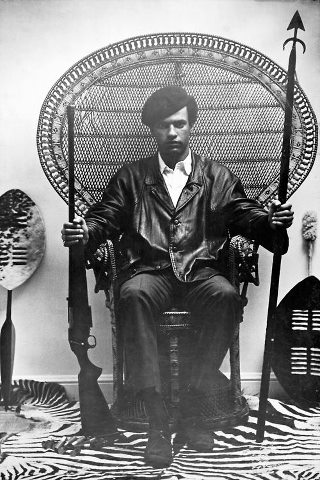
(Huey P. Newton)
Dr. Huey Percy Newton was born February 17, 1942 in Monroe, Louisiana, USA. In 1945 Newton’s family moved out to Oakland, CA.
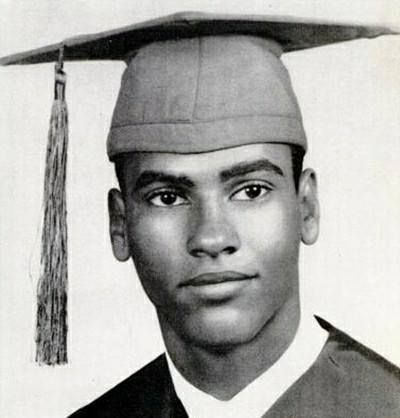
(Newton’s high school photo)
He attended Merritt College, San Francisco Law School, and the University of California Santa Cruz where he earned a bachelor's degree and later a Ph.D in social philosophy. In 1964 Newton was convicted of assault with a deadly weapon and served 6 months in jail. While attending Merritt College Newton became involved in the politics of the Bay Area. He joined the Afro-American Association and became a member of the fraternity Phi Beta Sigma. He played a role in getting the first African-American History course in Merritt College.  He read the works of Karl Marx, Vladimir Lenin, Frantz Fanon, Malcolm X, Mao Zedong, Durkheim, and Che Guevara during his time at Merritt College. Newton and friend Bobby Seale founded the Black Panther Party for Self Defense in October of 1966.
(Bobby Seale (Left) and Newton (Right) standing in front of the Black Panther Party HQ)
Bobby Seale became chairman of the organization and Newton became the minister of defense. Many of the Black Panther’s beliefs were influenced by Malcolm X. The party’s goals were included in their 10 point program. They promoted self defense and for Blacks to defend themselves from police brutality and other racially motivated attacks against them. Newton sought to educate those around him about the legality of self-defense while recruiting new members to the party. The Panthers did numerous things for the Bay Area community including founding the Oakland Community School, which provided high-level education to 150 children from impoverished urban neighborhoods. Other Panther programs included the Free Breakfast for Children Program and others that offered dances for teenagers and training in martial arts.
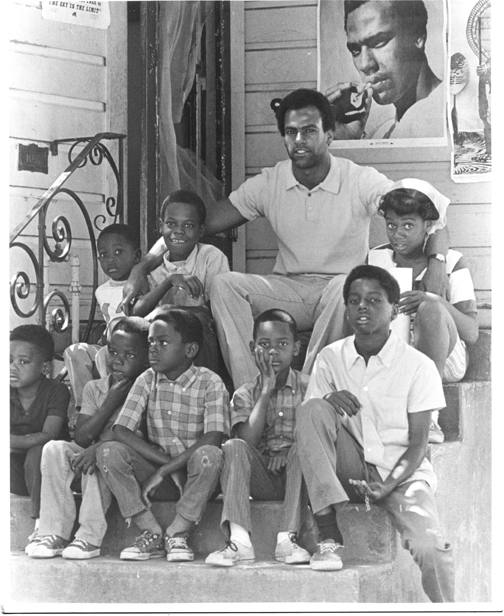
(Newton pictured with the local youth of Oakland, CA) On October 28th 1967 Newton and a friend were pulled over by Oakland Police officers. While trying to arrest Newton and his friend shots were fired and Newton and 2 police officers were wounded. 1 of the officers died from the bullet wounds. No guns were found on Newton or the officer that died. Newton was then arrested and charged for the death of the officer. Newton was convicted of voluntary manslaughter in September of 1968. He was sentenced to 2 to 15 years.
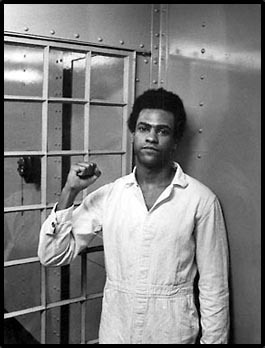
(Newton in jail after being convicted of voluntary manslaughter)
In May of 1970 the conviction was reversed and a new trial was ordered. The charges were dismissed after 2 new trials ending in hung juries. Newton received an invitation to visit the People’s Republic of China in 1970 and visited in 1971. He was greeted by thousands of people that were in support of the Black Panther Party.In 1974 he earned a bachelor’s degree from the University of California Santa Cruz. On August 6th 1974 Newton shot an 18 year old woman after she made him mad after a casual exchange. Newton and his girlfriend fled to Cuba and lived there until 1977.
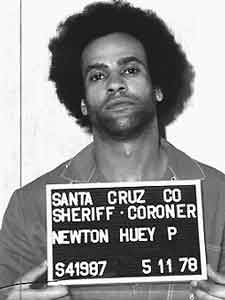
(Newton’s mugshot)
Newton was acquitted in September of 1978. Newton earned a Ph.D. in social philosophy at the University of California Santa Cruz in 1980.
(Newton at his graduation following earning his Ph.D.)
On August 22nd, 1989 Newton was fatally shot by a Black Guerrilla Family member in Oakland, CA. He was 47 years old.
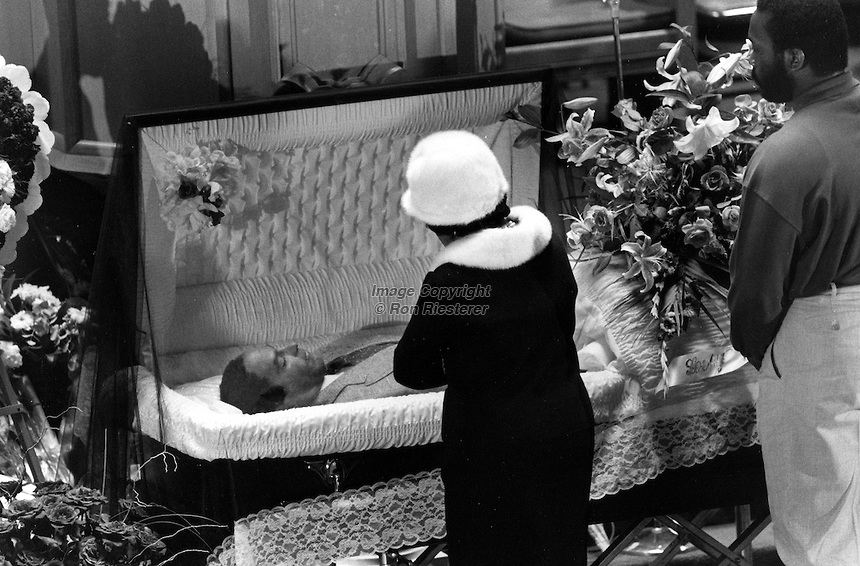
Image result for huey newton funeral(Newton’s Funeral)
Today is the 28th anniversary of his death. Take time to remember this great revolutionary today.

Movies Involving Huey P. Newton
  • Panther (1995)
  • A Huey P. Newton Story (2001)
  • The Black Panthers: Vanguard of the Revolution (2015)

Books Involving Huey P. Newton
  • To Die For the People (1972) By Huey P. Newton
  • Revolutionary Suicide (1973) By Huey P. Newton
  • War Against the Panthers (1980) By Huey P. Newton

Videos including Huey P. Newton

Tuesday, August 8, 2017

Happy Birthday Louis Armstrong

“If you have to ask what jazz is, you'll never know” - Louis Armstrong
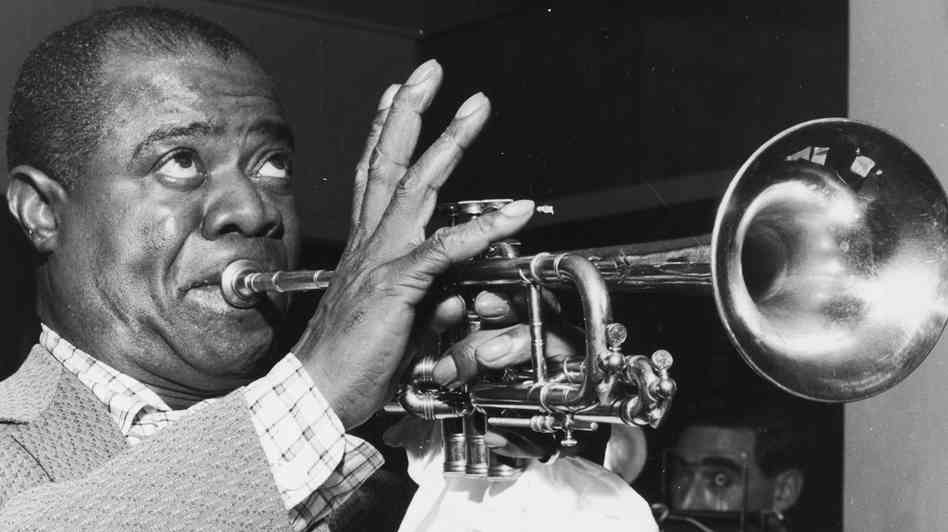
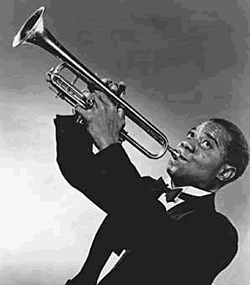
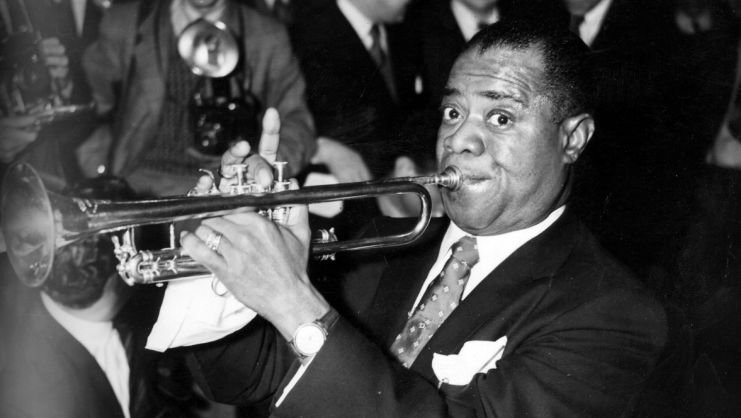
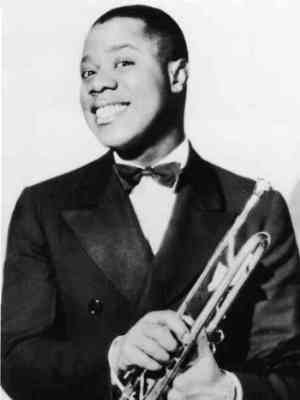
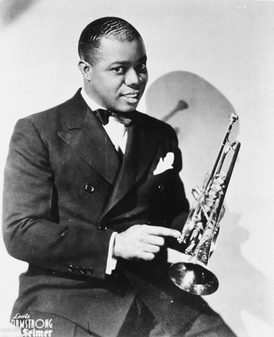
(Louis Armstrong)
Louis Armstrong was born on August 4th, 1901 in New Orleans, Louisiana, USA. He spent his youth in poverty, in a rough neighborhood known as "the Battlefield". His father left the family while he was a child. As a child his mother left him to live with his grandmother. At 5 years old he moved back to live with his mother and her relatives. He brought in some money as a paperboy and also by finding discarded food and selling it to restaurants, but it was not enough to keep his mother from prostitution. He would listen to bands play in clubs and dance halls.
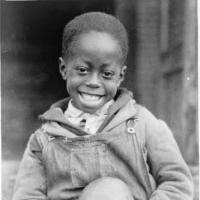
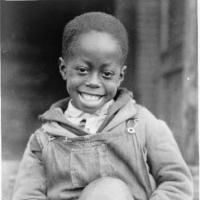
(Armstrong as a young child)
At age 11 Armstrong dropped out of school and joined a quartet of boys who sang in the streets for money. He began to play the trumpet by ear at the same age. He also worked for a Lithuanian immigrant family who treated him like family. Armstrong developed his cornet playing skills by playing in the band of the New Orleans Home for Colored Waifs. Professor Peter Davis instilled discipline in and provided musical training to the otherwise self taught Armstrong. At 13 years old Armstrong became the band leader. At 14 years old he moved in with his father. Armstrong hauled coal by day and played his cornet at night. He played in the city's frequent brass band parades and listened to older musicians every chance he got. In 1919 He became second trumpet for the Tuxedo Brass Band.
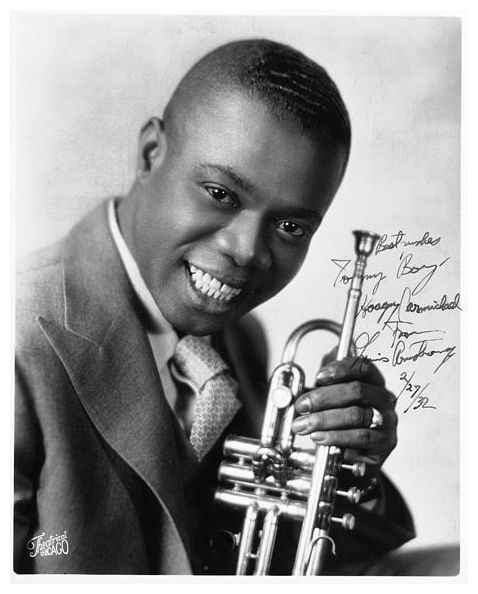
(Armstrong in 1919)
At 20 years old he could read music and started to be featured in extended trumpet solos, one of the first jazz men to do this. In 1922 Armstrong joined the exodus to Chicago. Armstrong lived luxuriously in Chicago.
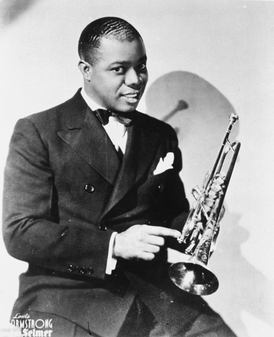
(Armstrong in 1922)
In 1923 Armstrong made his first recordings. In 1924 Armstrong received an invitation to go to New York City to play with the Fletcher Henderson Orchestra. Armstrong then included singing in his performances. In 1925 he returned to chicago.
(Armstrong in 1925)
He began recording under his own name for Okeh with his famous Hot Five and Hot Seven groups. The group included Kid Ory (trombone), Johnny Dodds (clarinet), Johnny St. Cyr (banjo), and his wife Lil (piano). The most notable of the Hot Five and Seven records were "Cornet Chop Suey", "Struttin' With Some Barbecue", "Hotter Than that" and "Potato Head Blues”. In 1926 Armstrong was 1st to scat sing on record. In 1929 he returned to New York City. Also he played in the pit orchestra of the successful musical “Hot Chocolate”.
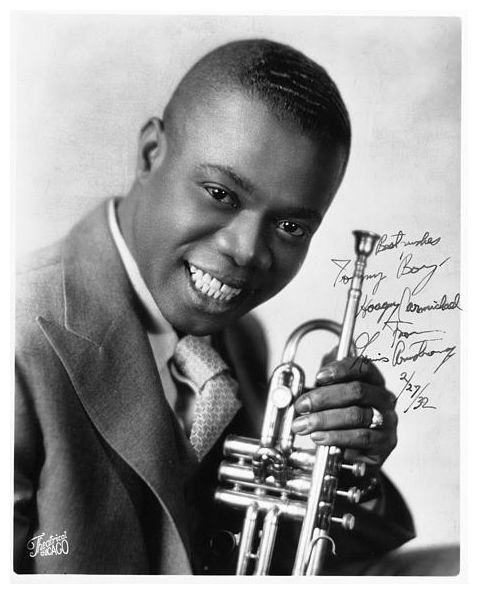
(Armstrong in 1929)
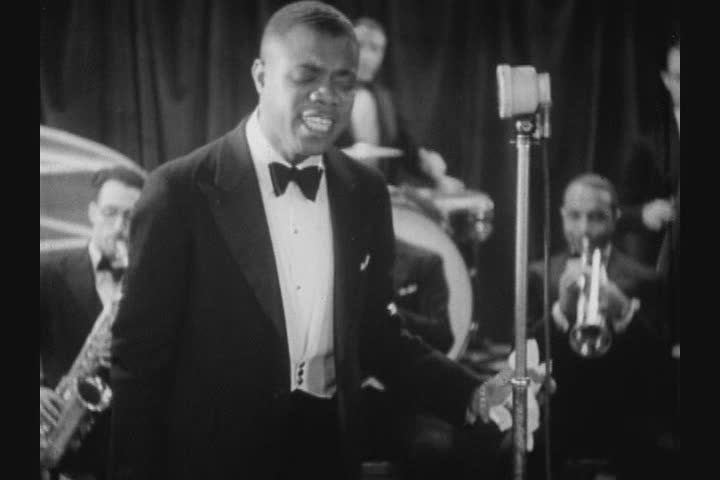
In 1930 Armstrong moved to Los Angeles, CA. He played at the New Cotton Club in Los Angeles, CA with Lionel Hampton on drums. In 1931 Armstrong took full advantage of the new RCA ribbon microphone. Armstrong's famous interpretation of Hoagy Carmichael's "Stardust" became one of the most successful versions of this song ever recorded. Also in 1931 Armstrong appeared in his first movie, Ex-Flame.
(Armstrong in Ex Flame(1931))
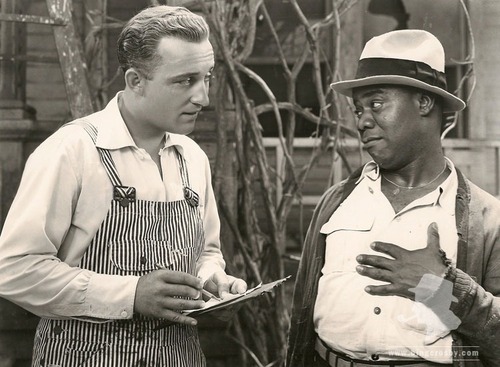
He then moved to Chicago, IL. He also visited New Orleans, LA and had a hero's welcome. He sponsored a local baseball team known as "Armstrong's Secret Nine" and had a cigar named after him. In 1936 he appeared in Pennies from Heaven.
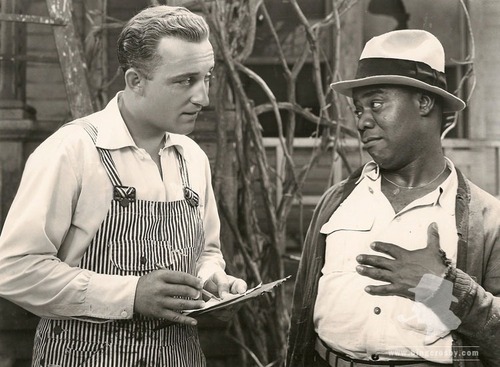
(Armstrong (Right) in Pennies From Heaven (1936))
In 1937, Armstrong substituted for Rudy Vallee on the CBS radio network and became the first African American to host a sponsored national broadcast. In 1943 he moved to Queens, NY. Throughout the 1940’s Armstrong played over 300 gigs a year. In 1947 Armstrong formed the group “Louis Armstrong and his All Stars”.
(Armstrong in 1947)
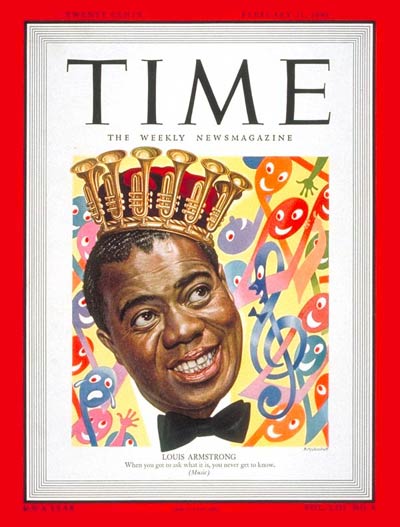
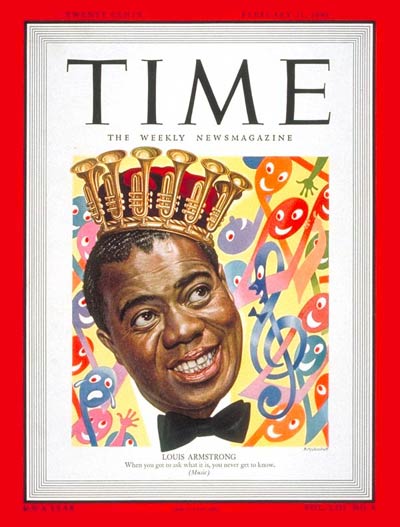
In 1948, he participated in the Nice Jazz Festival. In 1949 he was the first jazz musician to appear on the cover of “Time” magazine.
(Armstrong on “Time” magazine in 1949)
In 1950 Armstrong recorded the first American version of "C'est si bon”. In the 1960s, he toured Ghana and Nigeria. In 1964 he recorded his biggest selling record, "Hello, Dolly!".
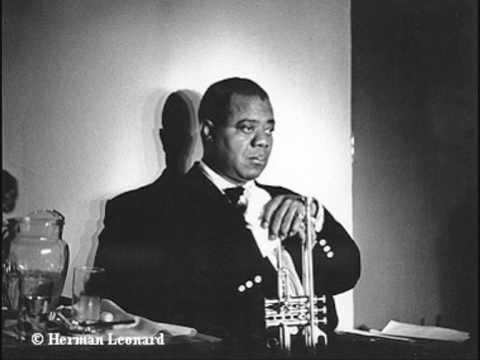
(Armstrong in 1964)
The record went number 1 on the Hot 100 charts making Armstrong, at 62 years, 9 months and 5 days, the oldest person ever to accomplish that feat. In 1968 Armstrong made his last recorded trumpet performance on the album “Disney Songs the Satchmo Way”.
(Armstrong in 1968)
On July 6th, 1971 Louis Armstrong died of a heart attack in New York City, New York, USA. He Was 69 years old.
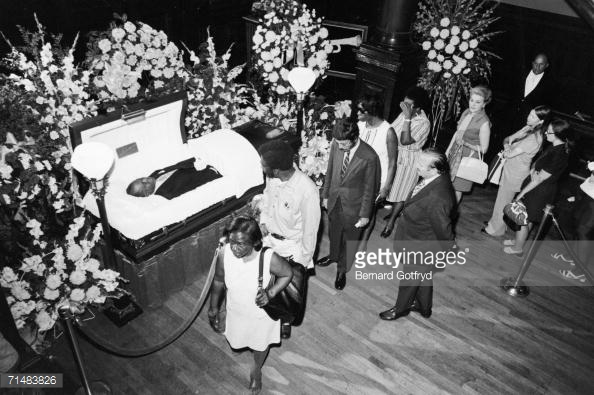
(Armstrong’s funeral)
Today is his 116th birthday and we would all like to say happy birthday and rest in peace Louis Armstrong.

Albums by Louis Armstrong
  • “Satchmo at Symphony Hall” (1951)
  • “Satchmo at Pasadena” (1951)
  • “Louis Armstrong Plays W.C. Handy” (1954)
  • “Louis Armstrong and the Mills Brothers, Volume One” (1954)
  • “Satch Plays Fats: A Tribute to the Immortal Fats Waller” (1955)
  • “Louis Armstrong at the Crescendo, Vol. 1” (1955)
  • “Louis Armstrong and Eddie Condon at Newport” (1956)
  • “Satchmo the Great” (1956)
  • “An Evening With Louis Armstrong and His All Stars” (1956)
  • “Ella and Louis” (1956)
  • “Ella and Louis Again” (1957)
  • “I've Got the World on a String” (1957)
  • “Louis Armstrong Meets Oscar Peterson” (1957)
  • “Louis Under the Stars” (1957)
  • “Louis and the Angels” (1957)
  • “Porgy & Bess” (1958)
  • “Louis and the Good Book” (1958)
  • “Satchmo In Style” (1959)
  • “The Five Pennies” (1959)
  • “Bing & Satchmo” (1960)
  • “Recording Together for the First Time” (1961)
  • “The Great Reunion” (1961)
  • “The Real Ambassadors” (1962)
  • “Hello, Dolly!” (1964)
  • “Disney Songs the Satchmo Way” (1968)
  • “The One and Only” (1968)
  • “What a Wonderful World” (1970)

Films Starring Louis Armstrong
  • Ex Flame (1930) as himself
  • I’ll Be Glad When You’re Dead You Rascal (1932) as himself
  • A Rhapsody in Black and Blue (1932) as himself
  • Pennies from Heaven (1936) as Hery
  • Artists & Models (1937) as Speciality
  • Every Day’s a Holiday (1937) as himself
  • Doctor Rhythm (1938) as Trumpet Player
  • Going Places (1938) as Gabe
  • Birth of the Blues (1941) as himself
  • Cabin in the Sky (1943) as The Trumpeter
  • Jam Session (1944) as himself
  • Pillow to Post (1945) as Orchestra Leader
  • New Orleans (1947) as himself
  • A Song is Born (1948) as himself
  • I’m in the Revue (1950) as Band Leader
  • The Strip (1951) as himself
  • Here Comes the Groom (1951) as himself
  • Glory Alley (1952) as Shadow Johnson
  • High Society (1956) as himself
  • The Five Pennies (1959) as himself
  • The Beat Generation (1959) as himself
  • Kærlighedens melodi (1959) as Musician
  • Paris Blues (1961) as Wild Man Moore
  • When the Boys Meet the Girls (1965) as himself
  • A Man Called Adam (1966) as Willie Ferguson
  • Hello, Dolly! (1969) as Orchestra Leader

Videos of Louis Armstrong

Wednesday, July 12, 2017

Anniversary of Louis Armstrong's Death

“If you have to ask what jazz is, you'll never know” - Louis Armstrong
(Louis Armstrong)
Louis Armstrong was born on August 4th, 1901 in New Orleans, Louisiana, USA. He spent his youth in poverty, in a rough neighborhood known as "the Battlefield". His father left the family while he was a child. As a child his mother left him to live with his grandmother. At 5 years old he moved back to live with his mother and her relatives. He brought in some money as a paperboy and also by finding discarded food and selling it to restaurants, but it was not enough to keep his mother from prostitution. He would listen to bands play in clubs and dance halls.
(Armstrong as a young child)
At age 11 Armstrong dropped out of school and joined a quartet of boys who sang in the streets for money. He began to play the trumpet by ear at the same age. He also worked for a Lithuanian immigrant family who treated him like family. Armstrong developed his cornet playing skills by playing in the band of the New Orleans Home for Colored Waifs. Professor Peter Davis instilled discipline in and provided musical training to the otherwise self taught Armstrong. At 13 years old Armstrong became the band leader. At 14 years old he moved in with his father. Armstrong hauled coal by day and played his cornet at night. He played in the city's frequent brass band parades and listened to older musicians every chance he got. In 1919 He became second trumpet for the Tuxedo Brass Band.
(Armstrong in 1919)
At 20 years old he could read music and started to be featured in extended trumpet solos, one of the first jazz men to do this. In 1922 Armstrong joined the exodus to Chicago. Armstrong lived luxuriously in Chicago.
(Armstrong in 1922)
In 1923 Armstrong made his first recordings. In 1924 Armstrong received an invitation to go to New York City to play with the Fletcher Henderson Orchestra. Armstrong then included singing in his performances. In 1925 he returned to chicago.
(Armstrong in 1925)
He began recording under his own name for Okeh with his famous Hot Five and Hot Seven groups. The group included Kid Ory (trombone), Johnny Dodds (clarinet), Johnny St. Cyr (banjo), and his wife Lil (piano). The most notable of the Hot Five and Seven records were "Cornet Chop Suey", "Struttin' With Some Barbecue", "Hotter Than that" and "Potato Head Blues”. In 1926 Armstrong was 1st to scat sing on record. In 1929 he returned to New York City. Also he played in the pit orchestra of the successful musical “Hot Chocolate”.
(Armstrong in 1929)
In 1930 Armstrong moved to Los Angeles, CA. He played at the New Cotton Club in Los Angeles, CA with Lionel Hampton on drums. In 1931 Armstrong took full advantage of the new RCA ribbon microphone. Armstrong's famous interpretation of Hoagy Carmichael's "Stardust" became one of the most successful versions of this song ever recorded. Also in 1931 Armstrong appeared in his first movie, Ex-Flame.
(Armstrong in Ex Flame(1931))
He then moved to Chicago, IL. He also visited New Orleans, LA and had a hero's welcome. He sponsored a local baseball team known as "Armstrong's Secret Nine" and had a cigar named after him. In 1936 he appeared in Pennies from Heaven.
(Armstrong (Right) in Pennies From Heaven (1936))
In 1937, Armstrong substituted for Rudy Vallee on the CBS radio network and became the first African American to host a sponsored national broadcast. In 1943 he moved to Queens, NY. Throughout the 1940’s Armstrong played over 300 gigs a year. In 1947 Armstrong formed the group “Louis Armstrong and his All Stars”.
(Armstrong in 1947)
In 1948, he participated in the Nice Jazz Festival. In 1949 he was the first jazz musician to appear on the cover of “Time” magazine.
(Armstrong on “Time” magazine in 1949)
In 1950 Armstrong recorded the first American version of "C'est si bon”. In the 1960s, he toured Ghana and Nigeria. In 1964 he recorded his biggest selling record, "Hello, Dolly!".
(Armstrong in 1964)
The record went number 1 on the Hot 100 charts making Armstrong, at 62 years, 9 months and 5 days, the oldest person ever to accomplish that feat. In 1968 Armstrong made his last recorded trumpet performance on the album “Disney Songs the Satchmo Way”.
(Armstrong in 1968)
On July 6th, 1971 Louis Armstrong died of a heart attack in New York City, New York, USA. He Was 69 years old.
(Armstrong’s funeral)
Today is the 46th anniversary of his death. Take time to remember this great musical artist today.

Albums by Louis Armstrong
  • “Satchmo at Symphony Hall” (1951)
  • “Satchmo at Pasadena” (1951)
  • “Louis Armstrong Plays W.C. Handy” (1954)
  • “Louis Armstrong and the Mills Brothers, Volume One” (1954)
  • “Satch Plays Fats: A Tribute to the Immortal Fats Waller” (1955)
  • “Louis Armstrong at the Crescendo, Vol. 1” (1955)
  • “Louis Armstrong and Eddie Condon at Newport” (1956)
  • “Satchmo the Great” (1956)
  • “An Evening With Louis Armstrong and His All Stars” (1956)
  • “Ella and Louis” (1956)
  • “Ella and Louis Again” (1957)
  • “I've Got the World on a String” (1957)
  • “Louis Armstrong Meets Oscar Peterson” (1957)
  • “Louis Under the Stars” (1957)
  • “Louis and the Angels” (1957)
  • “Porgy & Bess” (1958)
  • “Louis and the Good Book” (1958)
  • “Satchmo In Style” (1959)
  • “The Five Pennies” (1959)
  • “Bing & Satchmo” (1960)
  • “Recording Together for the First Time” (1961)
  • “The Great Reunion” (1961)
  • “The Real Ambassadors” (1962)
  • “Hello, Dolly!” (1964)
  • “Disney Songs the Satchmo Way” (1968)
  • “The One and Only” (1968)
  • “What a Wonderful World” (1970)

Films Starring Louis Armstrong
  • Ex Flame (1930) as himself
  • I’ll Be Glad When You’re Dead You Rascal (1932) as himself
  • A Rhapsody in Black and Blue (1932) as himself
  • Pennies from Heaven (1936) as Hery
  • Artists & Models (1937) as Speciality
  • Every Day’s a Holiday (1937) as himself
  • Doctor Rhythm (1938) as Trumpet Player
  • Going Places (1938) as Gabe
  • Birth of the Blues (1941) as himself
  • Cabin in the Sky (1943) as The Trumpeter
  • Jam Session (1944) as himself
  • Pillow to Post (1945) as Orchestra Leader
  • New Orleans (1947) as himself
  • A Song is Born (1948) as himself
  • I’m in the Revue (1950) as Band Leader
  • The Strip (1951) as himself
  • Here Comes the Groom (1951) as himself
  • Glory Alley (1952) as Shadow Johnson
  • High Society (1956) as himself
  • The Five Pennies (1959) as himself
  • The Beat Generation (1959) as himself
  • Kærlighedens melodi (1959) as Musician
  • Paris Blues (1961) as Wild Man Moore
  • When the Boys Meet the Girls (1965) as himself
  • A Man Called Adam (1966) as Willie Ferguson
  • Hello, Dolly! (1969) as Orchestra Leader

Videos of Louis Armstrong