Crate Diggers: Frederick Douglass
Showing posts with label Frederick Douglass. Show all posts

Sunday, July 16, 2017

Happy Birthday Ida B. Wells

“The only times an Afro-American who was assaulted got away has been when he had a gun and used it in self defense” - Ida B. Wells
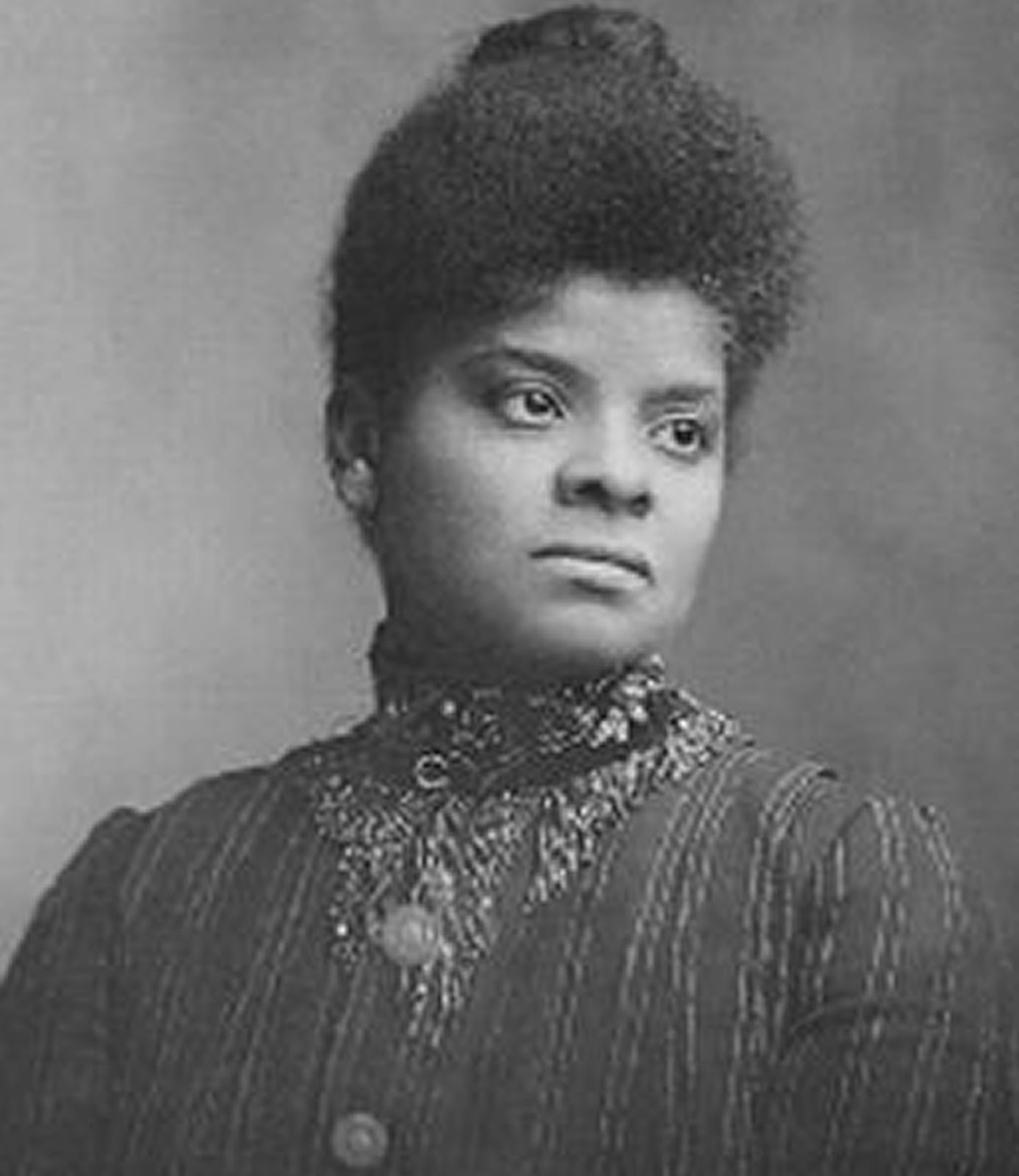
(Ida B. Wells)
Ida B. Wells was born on July 16th, 1862 in Holly Springs, Mississippi, USA. She was born into slavery. Wells attended Shaw University but she was expelled for rebellious behavior after confronting the college president. In 1878 her parents and her infant brother died due to yellow fever. She found work as a teacher in a black elementary school in order to keep her younger siblings together as a family. Her paternal grandmother, Peggy Wells, along with other friends and relatives, stayed with her siblings and cared for them during the week while Wells was away teaching. Wells resented that in the segregated school system, white teachers were paid $80 a month and she was paid only $30 a month. This discrimination made her more interested in the politics of race and improving the education of blacks. In 1883 Wells took three of her younger siblings to Memphis, TN to live with her aunt. During her summer vacations she attended summer sessions at Fisk University. She held strong political opinions and provoked many people with her views on women's rights. In 1884 a train conductor with the Memphis and Charleston Railroad ordered Wells to give up her seat in the first class ladies car and move to the smoking car, which was already crowded with other passengers. Wells refused to give up her seat. The conductor and 2 men dragged Wells out of the car. Wells then hired an African American attorney to sue the railroad. She won the case and was awarded $500. In 1887 The railroad company appealed to the Tennessee Supreme Court, which reversed the lower court's ruling.
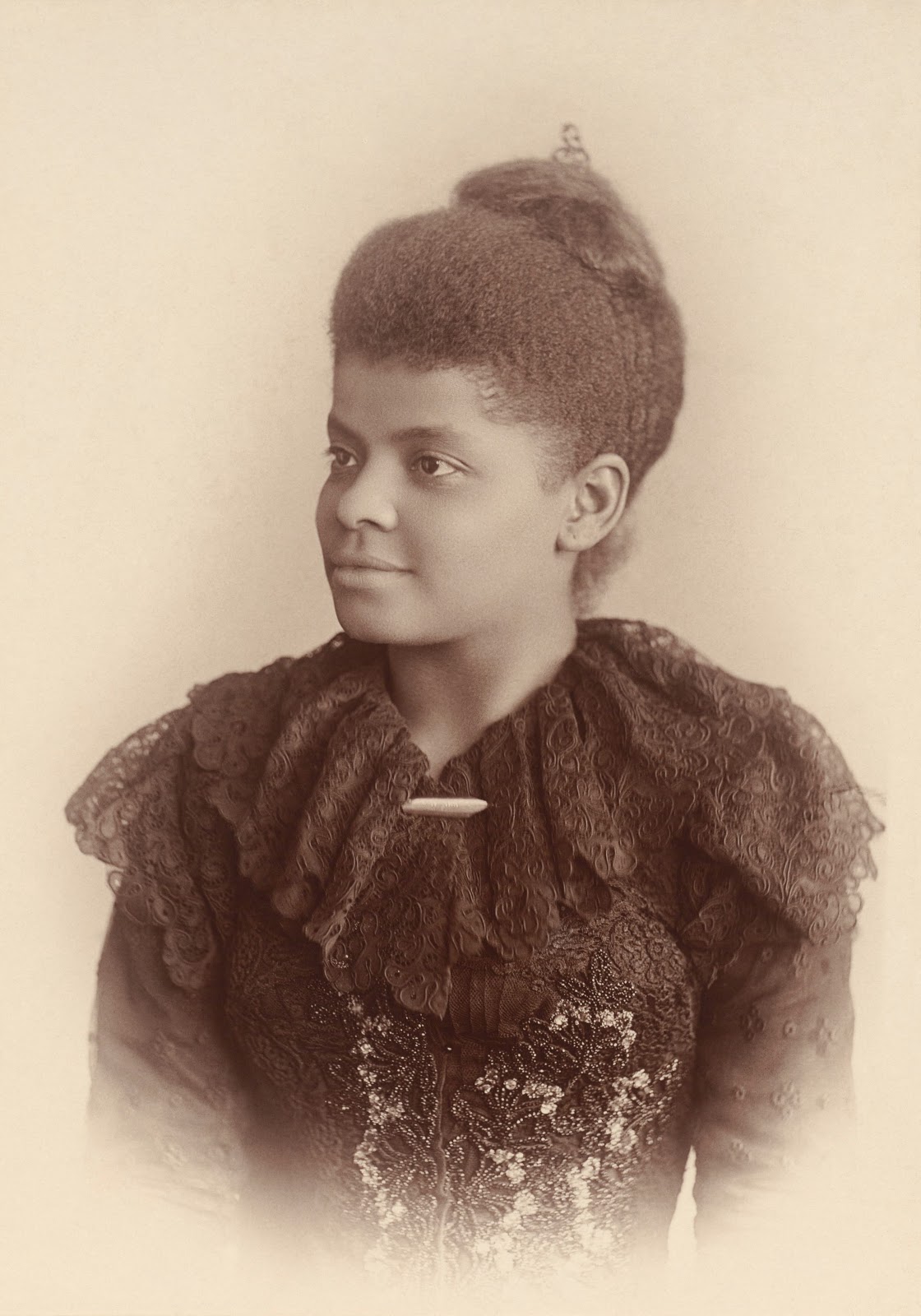
(Wells in 1887)
In 1889 she became co owner and editor of “Free Speech and Headlight”, an anti segregation newspaper. In 1891 Wells was dismissed from her teaching post by the Memphis Board of Education due to the various articles she had written which critiqued the conditions in the colored schools of the region. In 1889 after 3 of her friends were lynched she wrote in “Free Speech and Headlight”, urging blacks to leave Memphis, TN altogether.
(Wells in 1890)
More than 6,000 blacks did leave Memphis. Others organized boycotts of white owned businesses. After being threatened with violence, she bought a pistol. She then began investigative journalism. This officially started her anti lynching campaign. Wells found that Blacks were lynched for such social control reasons as failing to pay debts, not appearing to give way to whites, competing with whites economically, and being drunk in public. She found little basis for the frequent claim that Blacks were lynched because they had sexually abused or attacked white women, which was the alibi that partly accounted for White America's collective acceptance or silence on lynching. In 1892 while she was away in Philadelphia, PA a mob destroyed the offices of the “Free Speech and Headlight” in retaliation for her controversial articles. Wells left Memphis, TN and moved to Chicago, IL due to threats on her life. Also in 1892 Wells published a pamphlet titled “Southern Horrors: Lynch Law in All Its Phases”. Wells recommended that blacks use arms to defend against lynching.
(Wells in 1892)
In 1893 together with Frederick Douglass and other black leaders, she organized a black boycott of the World's Columbian Exposition in Chicago, IL for having no exhibits to represent African American life. In 1894 Wells took a tour to Europe in her campaign for justice. Also in 1894 Wells helped form a Republican Women's Club in Illinois in response to women being granted the right to vote for a state elective office. In 1895 Wells married her attorney Ferdinand Barnett. In 1896 Wells founded the National Association of Colored Women's Clubs and the National Afro American Council. On March 25, 1931 Ida B. Wells died of kidney failure in Chicago, Illinois, USA. She was 68 years old.
(Wells in 1931)
Today is her 155th birthday and we would all like to say happy birthday and rest in peace Ida B. Wells.

Sunday, March 12, 2017

Anniversary of Harriet Tubman's Death

“I freed a thousand slaves I could have freed a thousand more if only they knew they were slaves” - Harriet Tubman
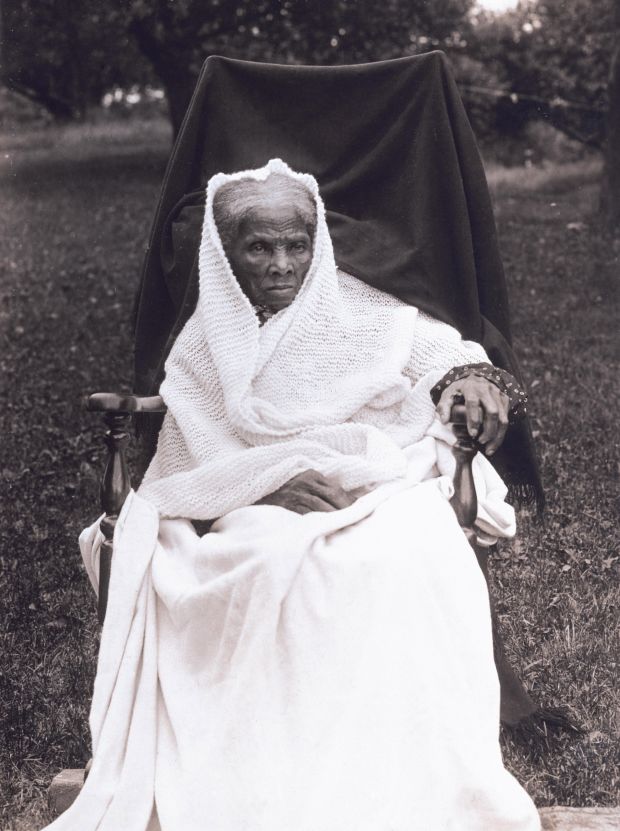
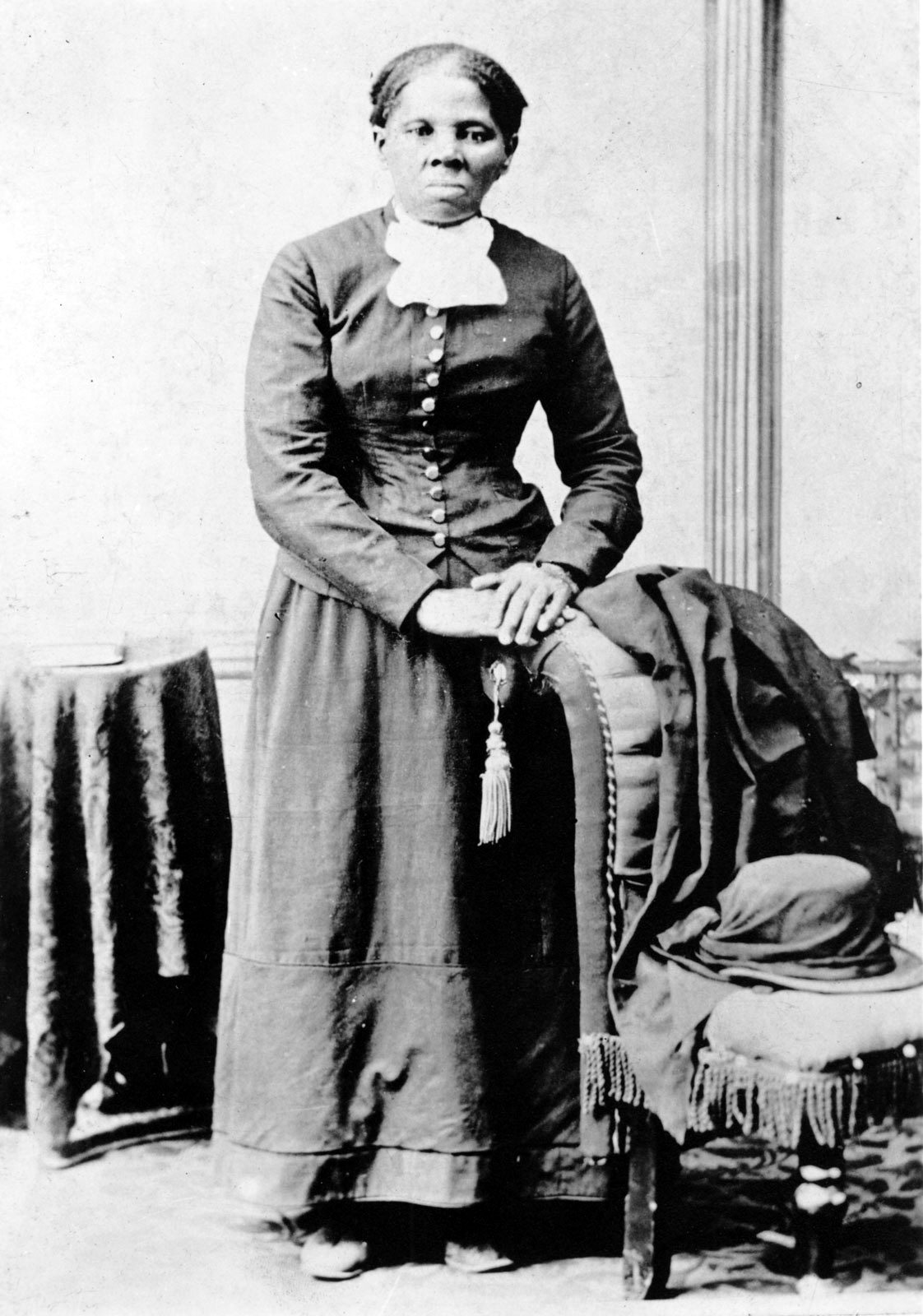
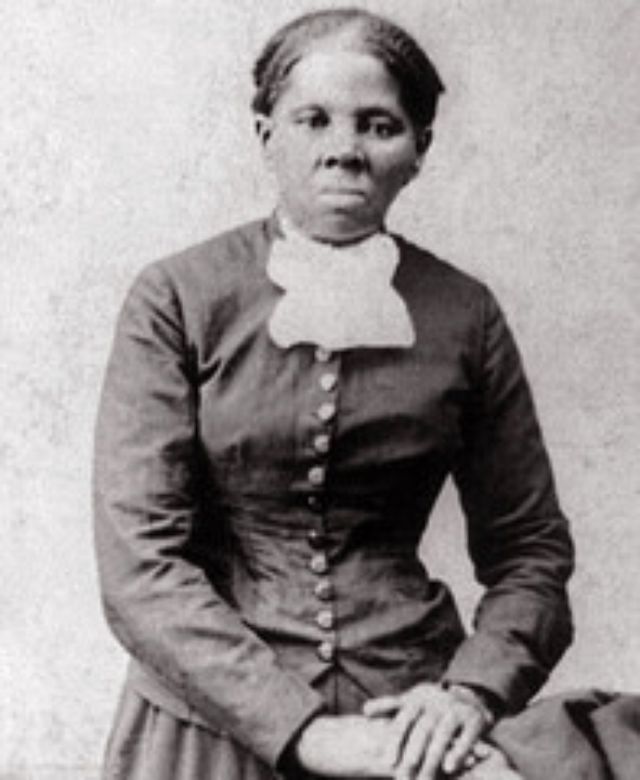
(Harriet Tubman)
Harriet Tubman was born as Araminta Ross on an unknown date in 1822 in Dorchester County, Maryland, USA. She was born into slavery. There is a discrepancy as to what exact year she was born. Ross took care of her younger siblings because her mother worked in the slave master’s house and didn't have too much time for the children. During childhood she would find ways to resist by wearing layers of clothing as protection against beatings and fighting back. As she grew older she was assigned to working in the field. One day Ross was sent to go get supplies from a store. At the store she saw a dispute between a slave and a slaveowner. The slave tried to run out of the store away from his master and his master threw a 2 pound weight at him but he struck Ross on accident. The injury caused disabling epileptic seizures, headaches, powerful visions, and dream experiences, which occurred throughout her life. Around 1844 Ross married a free Black man named John Tubman. Soon after the marriage she changed her name to Harriet Tubman, Harriet being her mother’s name. In 1849 Tubman’s master died and there was an increased likelihood that she was going to be sold and her family broken up. On September 17th, 1849 Tubman and her 2 brothers escaped. Her brothers had second thoughts about escaping so then they all returned back. Tubman escaped again this time alone. Tubman used the Underground Railroad to help her get North. She traveled through Delaware then through Pennsylvania. While in Philadelphia, PA she worked jobs to save up money.
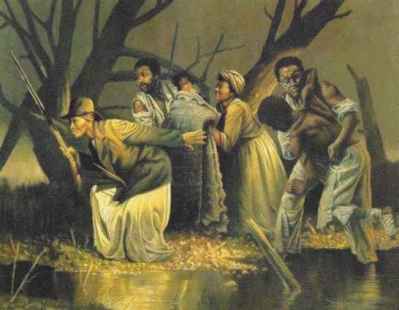
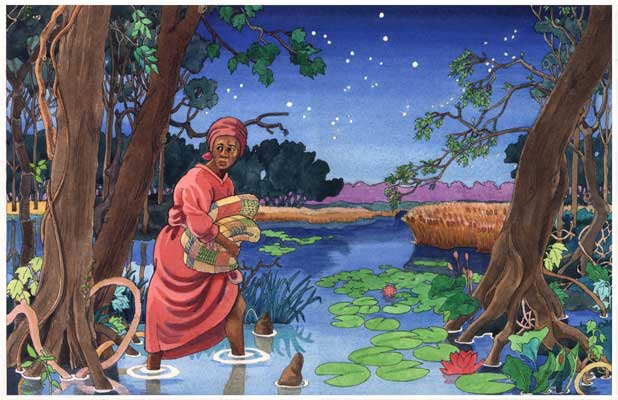
(A painting of Tubman)
In December of 1850 Tubman went to Baltimore, MD to help in the assistance of her niece and her kids escape. In the spring of 1851 she returned to help more families escape including one of her brothers. She was given the name “Moses” by abolitionist William Lloyd Garrison due to the connection of Moses from the Bible leading the Hebrews from slavery and Tubman leading African-Americans from slavery. She had a lot of help freeing slaves throughout Maryland. In the Fall of 1851 she returned to her place of birth to find her husband John Tubman. She found out that her husband had remarried and instead she found a group of slaves that she helped escape to Pennsylvania. In December of 1851 Tubman guided a group of 11 slaves into Canada due to the US’s Fugitive Slave Act of 1850. On the way to Canada they stopped at the home of abolitionist Frederick Douglass. Over 11 years Tubman freed 70 slaves from Maryland in 13 expeditions. She mostly worked in the Winter months due to the fact the nights were longer. She risked being seen by her former masters many times while going back to Maryland. She also had visions of herself speaking with God and she stated that God would protect her during her expeditions. Tubman carried firearms with her aswell for protection from slave catchers and to use if any slave she was helping was going to sell her out and get her caught.
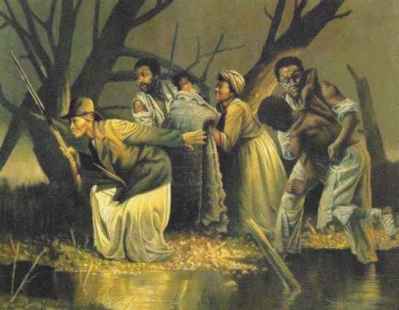
(A painting of Tubman (Left))
A lot of slaveholders thought a Northern White abolitionist were enticing slaves to run away or that John Brown was aiding in the escape of slaves. There has been an estimation of between $12,000 and $40,000 for Tubman’s capture. Tubman was never captured and none of the slaves she helped escaped were ever captured. Abolitionist John Brown worked with Tubman to recruit supporters for an attack on slave owners. Tubman was supposed to be with John Brown on his Raid on Harper’s Ferry in 1859 but she wasn't able to be contacted. In 1859 Tubman returned to the US and lived in Auburn, New York. In November of 1860 Tubman conducted her last rescue mission and brought a group of slaves to New York. During the Civil War, Tubman brought together a group of former slaves for a regiment of black soldiers.
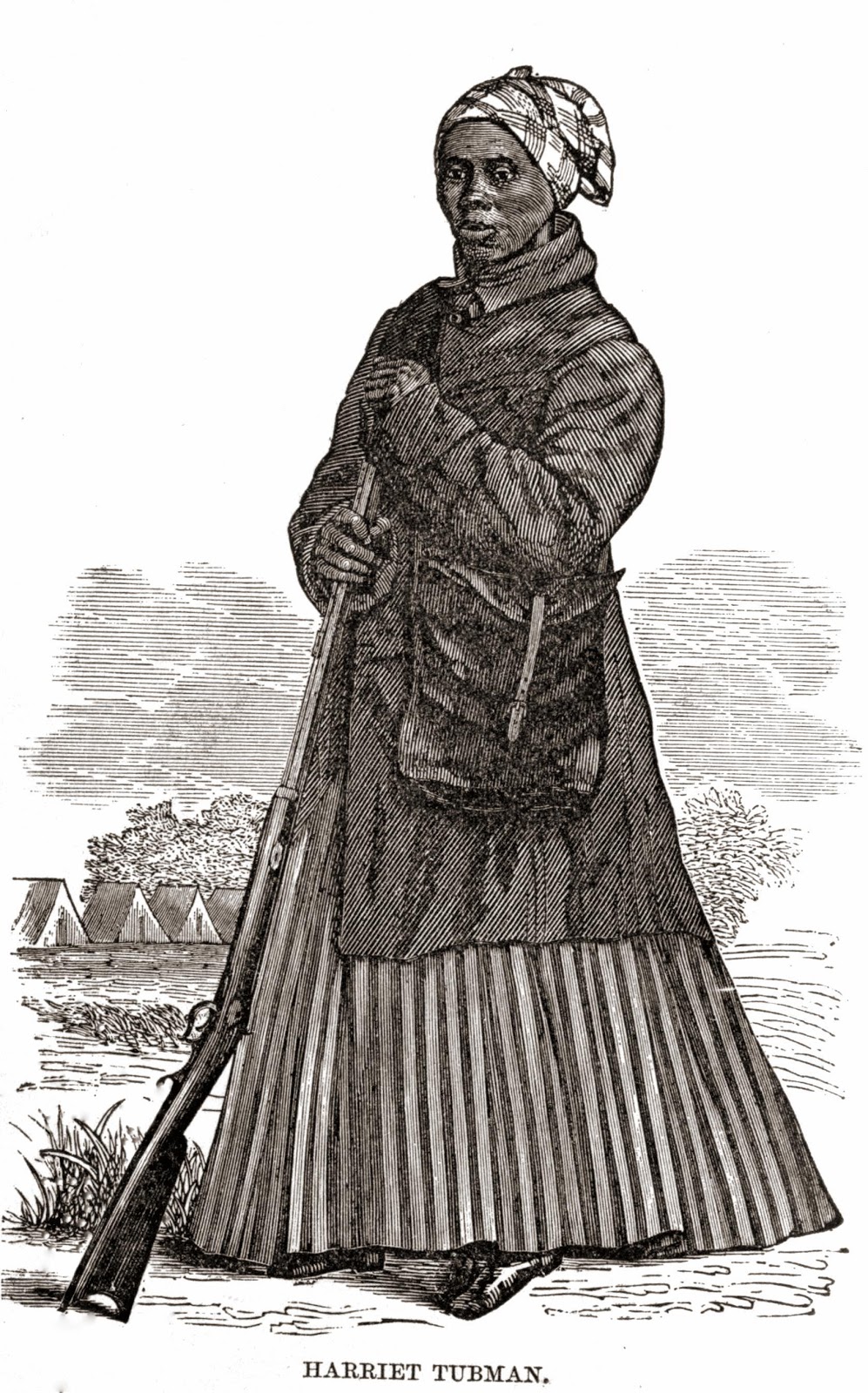
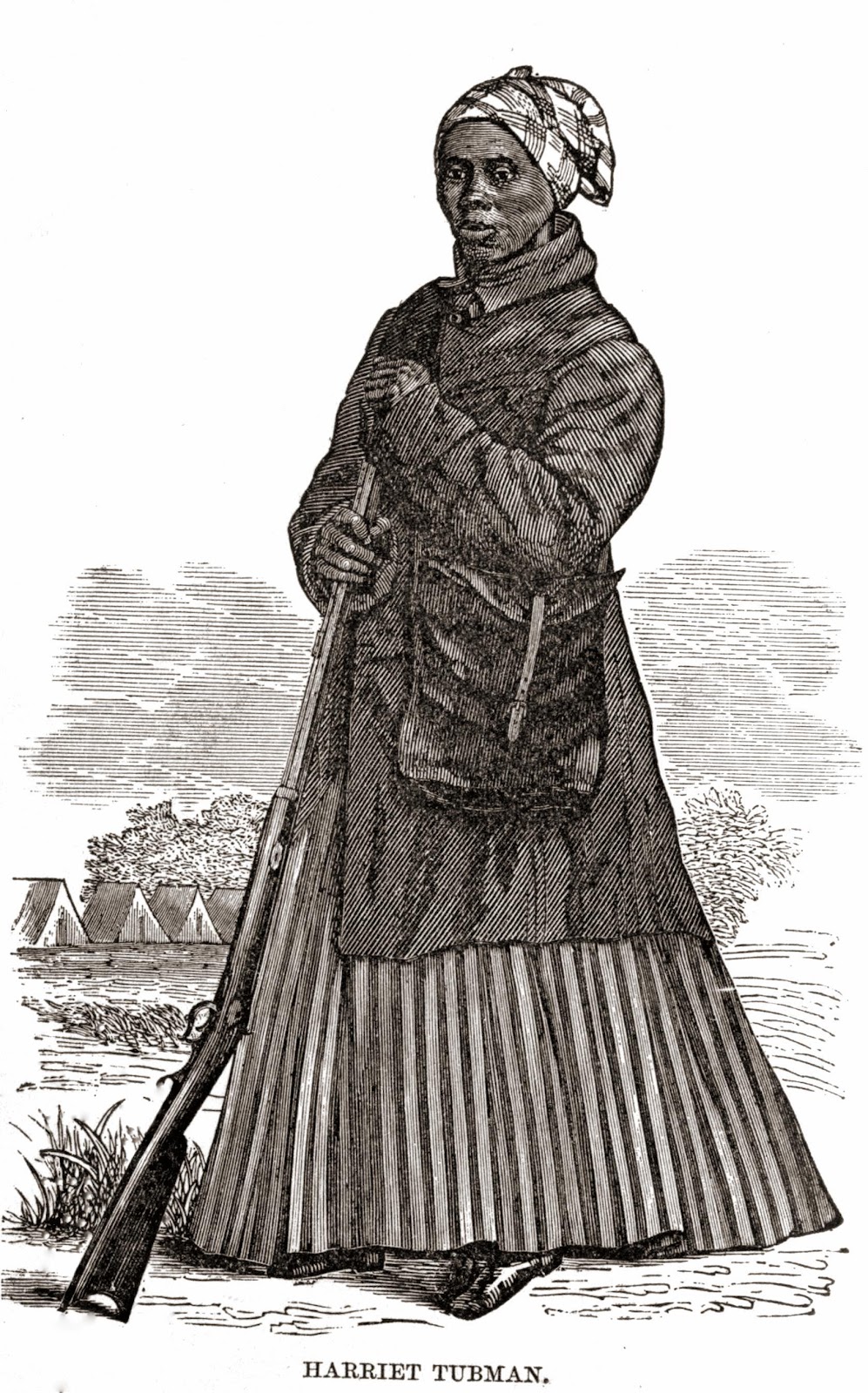
(A drawing of Tubman)
Tubman served as a nurse during the Civil War in Port Royal, SC. In 1863 she began to lead scouts through South Carolina. Tubman became the 1st woman to lead an armed assault in the Civil War. This assault involved freeing slaves from several plantations. More than 750 slaves were rescued. After the confederacy surrendered in 1865 Tubman returned to her home in New York. On her way back she was forced into the smoking car of the train she was riding and she suffered a broken arm from it while the White passengers wanted her thrown off the train. She never received any salary for her work during the Civil War. On March 18th, 1869 she was married to  a Civil War veteran named Nelson Davis. Also in 1869 a biography was written about her.
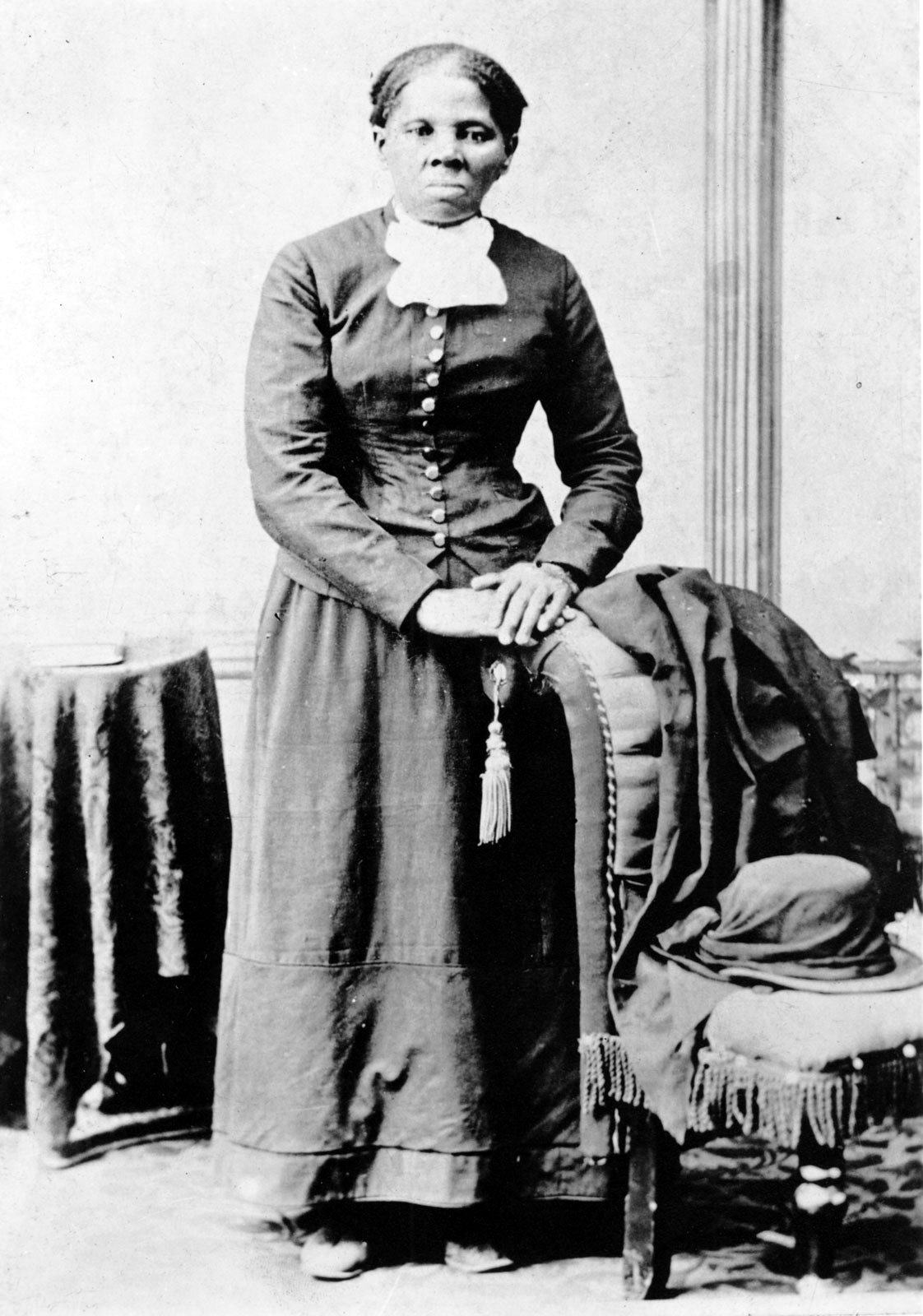
(Tubman in 1870)
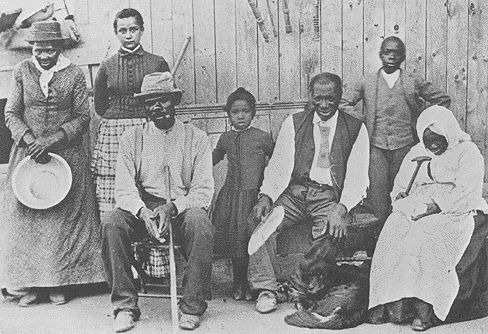
In 1873 Tubman was involved in a gold swindle. In 1886 another biography about her was written. In 1896 Tubman became a speaker for the National Federation of Afro-American Women. In 1899 she finally received pension for her service in the Union Army.In the late 1890’s Tubman underwent brain surgery to help with her constant seizures, headaches, and suffering from her childhood head trauma. She didn't use anesthesia, preferring to bite down on a bullet like soldiers did in the Civil War while having limbs amputated.  In 1900 she became involved with the African Methodist Episcopal Zion Church. In 1908 a parcel of real estate that Tubman donated to her church became the Harriet Tubman Home for the Aged.
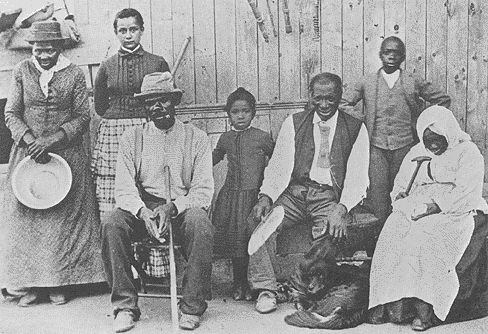
(Tubman (Left) with her family)
In 1911 she was admitted into the rest home. On March 10th, 1913 Harriet Tubman died of pneumonia in Auburn, New York. She was about 91 years old.
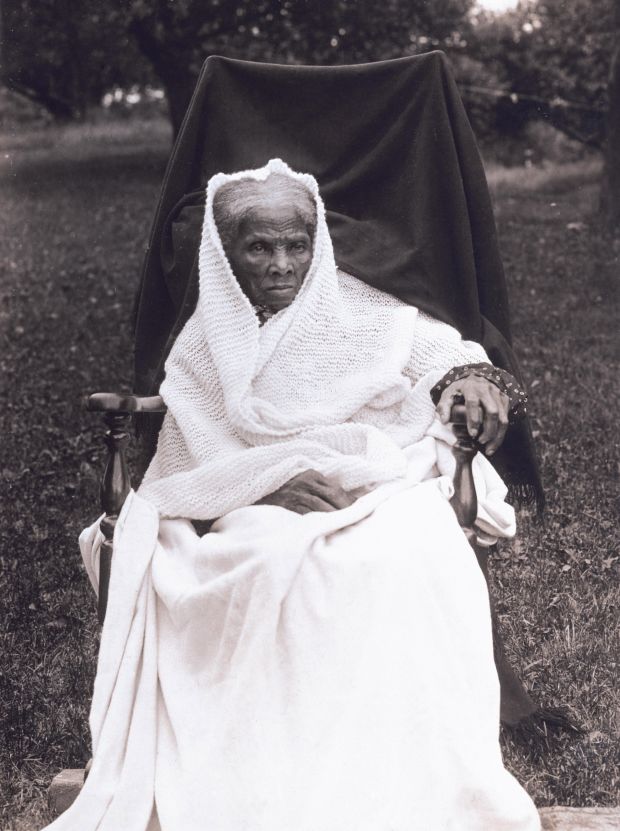
(Tubman in 1911)
Today is the 104th anniversary of her death. Take time to remember this great abolitionist today.

Books relating to Harriet Tubman
  • Scenes in the Life of Harriet Tubman (1869) by Sarah H. Bradford
  • Harriet Tubman: The Moses of Her People (1886) by Sarah H. Bradford
  • Harriet Tubman (2004) by Catherine Clinton


(P.S. sorry for the late post)

Monday, February 20, 2017

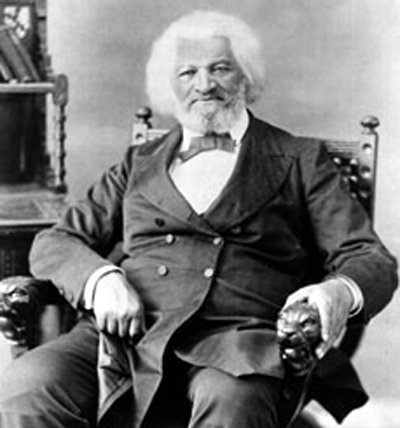
Anniversary of Frederick Douglass' Death

“It is easier to build strong children than to repair broken men” - Frederick Douglass
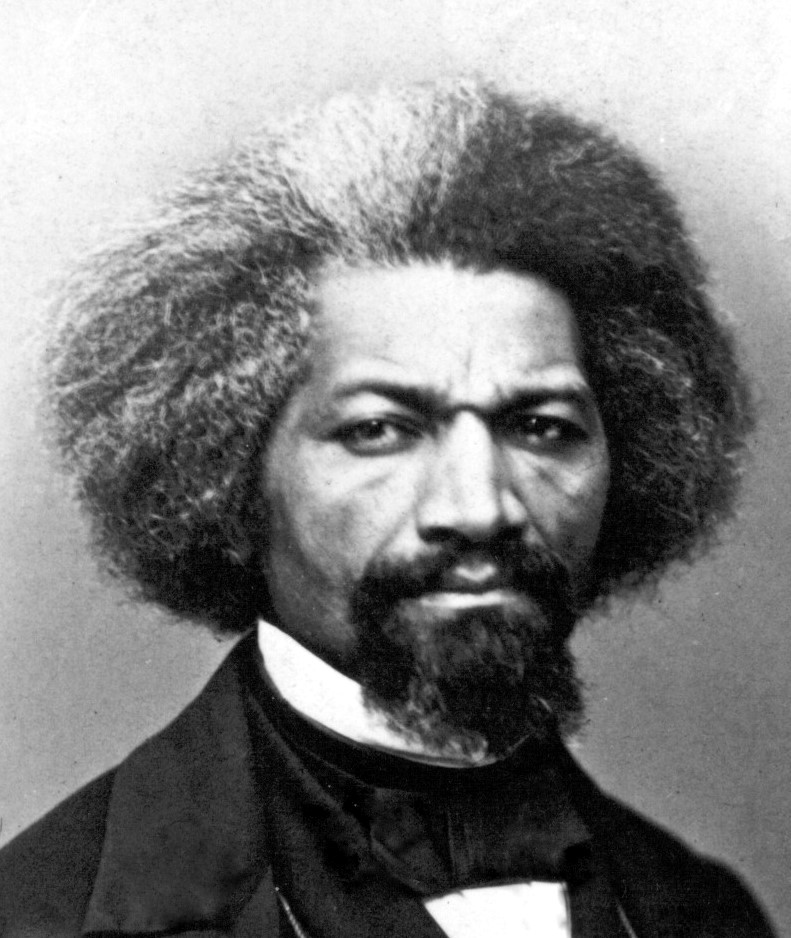
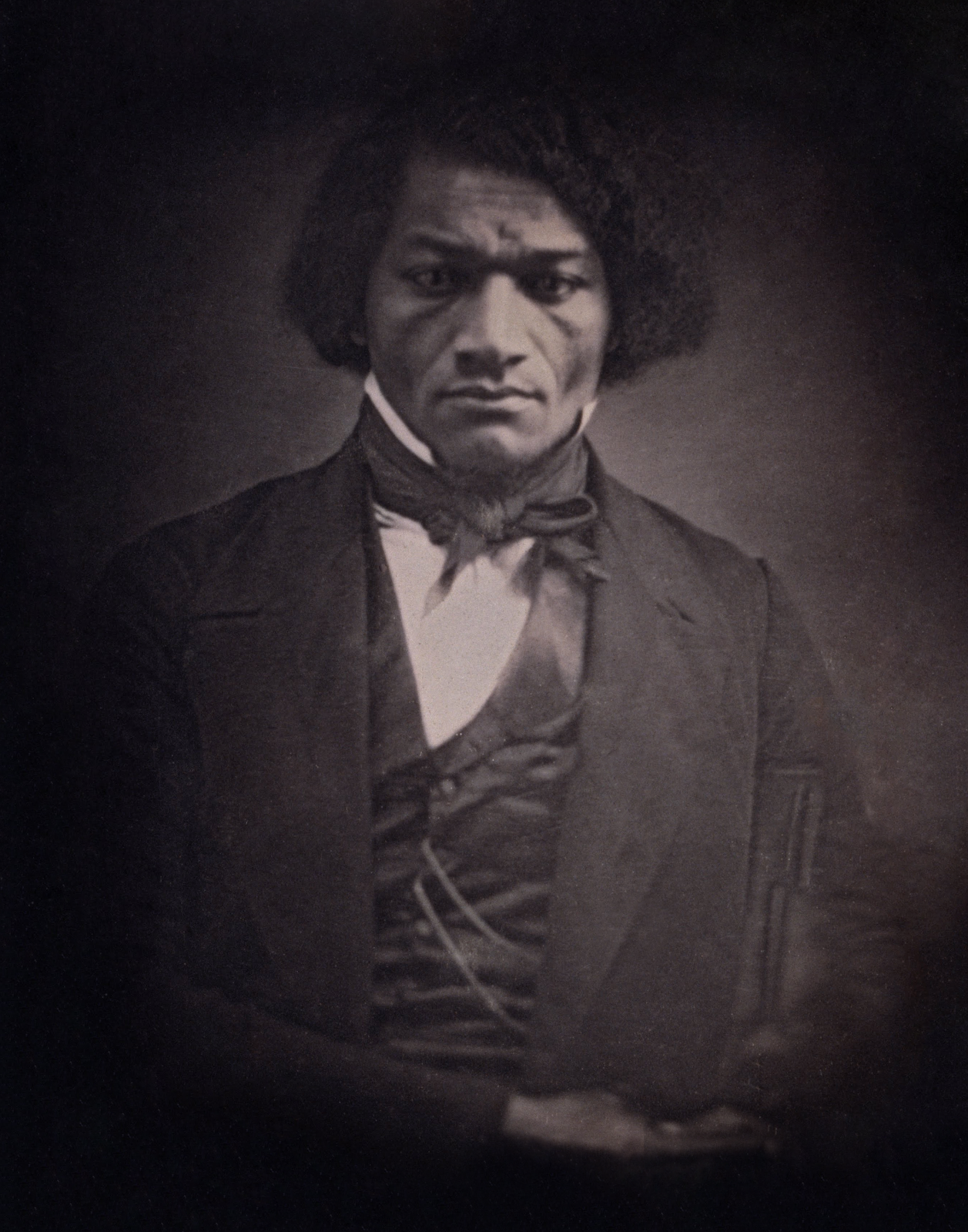
(Frederick Douglass)
Frederick Douglass was born as Frederick Augustus Washington Bailey in February of 1818 in Talbot County, Maryland, USA. He was born into slavery and the exact date of his birth is unknown. His father was a white man that he never met and his mother was a slave that his father raped. He was separated from his mother at a young age. He lived with his mother’s mother until the age of 7 where he was separated from her. His mother died when he was 10 years old. After one of his slave masters died he was moved to his deceased master’s brother in Baltimore,MD. When he was 12 his master’s wife started to teach him the alphabet.
(Douglass as a child)
His master disapproved of his wife teaching Douglass the alphabet as this may lead to him eventually wanting freedom. In private Douglass taught himself to read by reading newspapers, pamphlets and other forms of media. When his master hired him out to another slave master he taught those slaves to read the Bible at a sunday school which he taught classes at. More than 40 slaves would attend the class. These classes went on for 6 months unnoticed until 1 sunday a group of slave masters busted in to disperse the class. His 1st slave master took Douglass back and sent him to another slavemaster with the reputation of a “Slave Breaker”. Douglass was beat regularly and he was nearly broke mentally. At 16 years old Douglass finally fought back and beat his slave master in a fight and he was never whipped or beat again. In 1836 Douglass tried to escape but was unsuccessful. In 1837 Douglass met and fell in love with a free Black woman in Baltimore who was 5 years older than him named Anna Murray.
(Douglass’ wife, Anna Murray)
Moreover, on September 3rd, 1838 Douglass successfully escaped by a train that was traveling North. He traveled through the slave state of Delaware disguised as a sailor with fake documents saying he was a free man. He then got into the free state of Pennsylvania. From Pennsylvania he moved up to New York City, NY and stayed with a well known abolitionist. After settling in New York City he sent for his girlfriend Anna Murray. They married on September 15th, 1838. They adopted the name Johnson as their last name. They then moved to New Bedford, MA. They then changed their last name again to Douglass. Douglass became a licensed preacher in 1839. In 1840 he delivered a speech in Elmira, NY which was a station for the underground railroad. Douglass became a regular at abolitionist meetings in New Bedford, MA. Douglass drew inspiration from abolitionist William Lloyd Garrison. In 1841 Douglass heard Garrison speak at a meeting of the Bristol Anti-Slavery Society. At another meeting Douglass was unexpectedly invited to speak of his story of escaping slavery. Douglass was encouraged to become an anti-slavery lecturer. At 23 years old he spoke at an anti-slavery convention in Nantucket, MA. In 1843 Douglass joined other speakers on a 6 month tour through the Eastern and Midwestern parts of the US. At a lecture in Pendleton, Indiana an angry mob of slavery supporters chased and beat Douglass. He was rescued by a Quaker family.

Furthermore, Douglass suffered a broken hand that never healed properly. In 1845 Douglass published his book Narrative of the Life Frederick Douglass, An American Slave. Within three years, it had been reprinted nine times, with 11,000 copies circulating in the United States. It was also translated into French and Dutch and published in Europe.In 1845 Douglass went to tour Europe. on the 16th of August 1845 he arrived in Liverpool, England. He then traveled to Ireland. Douglass spent 2 years in Ireland and England. During his trip Douglass became legally free. Douglass returned to the US in Spring of 1847.
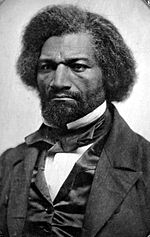
(Douglass in 1847)
Douglass published the first abolitionist paper called The North Star in Rochester,NY. In September of 1848 Douglass wrote a letter to his former slave master berating him for his conduct, and enquiring after members of his family still held by him. In 1848, Douglass was the only African American to attend the Seneca Falls Convention, the first women's rights convention, in upstate New York. Douglass stood and spoke eloquently in favor of women’s suffrage; he said that he could not accept the right to vote as a black man if women could not also claim that right. In 1851 Douglass merged The North Star with Gerrit Smith's Liberty Party Paper to form Frederick Douglass' Paper, which was published until 1860. On July 5, 1852, Douglass delivered an address to the ladies of the Rochester Anti-Slavery Sewing Society. This speech became known as “What to the slave is the 4th of July?".
(A drawing of Douglass)
Douglass met with abolitionist John Brown two months before Brown lead his raid on the federal armory in Harpers Ferry. Douglass disapproved of Brown's plan to start an armed slave rebellion in the South. After the raid, Douglass fled for a time to Canada, fearing guilt by association as well as arrest as a co-conspirator.
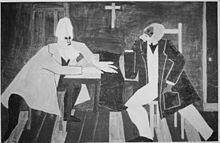
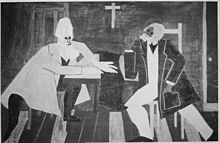
(A drawing of John Brown (Left) and Douglass (Right))
In 1855 he published his 2nd book My Bondage and My Freedom.
(Douglass in 1856)
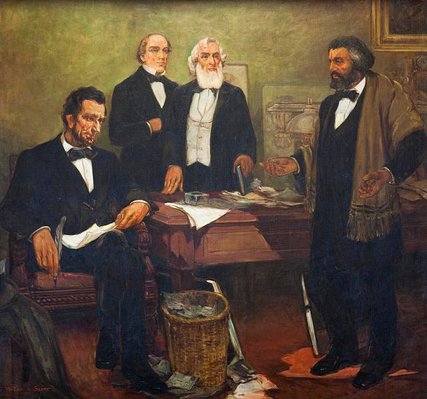
Douglass conferred with President Abraham Lincoln in 1863 on the treatment of black soldiers, and with President Andrew Johnson on the subject of black suffrage. During the U.S. Presidential Election of 1864, Douglass supported John C. Frémont. Douglass was disappointed that President Lincoln did not publicly endorse suffrage for blacks. Douglass believed that since African-American men were fighting for the Union in the American Civil War, they deserved the right to vote. Douglass helped the Union by serving as a recruiter for the 54th Massachusetts Infantry Regiment. In 1870, Douglass started his last newspaper, the New National Era, attempting to hold the US to its commitment to equality. In 1872, Douglass became the first African American nominated for Vice President of the United States, as Victoria Woodhull's running mate on the Equal Rights Party ticket. He was also presidential elector at large for the State of New York, and took that state's votes to Washington, D.C. His home in Rochester, NY was burned down by a suspected arsonist. Douglass then moved to Washington D.C.
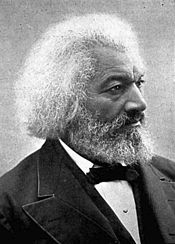
(Douglass in the 1870’s)
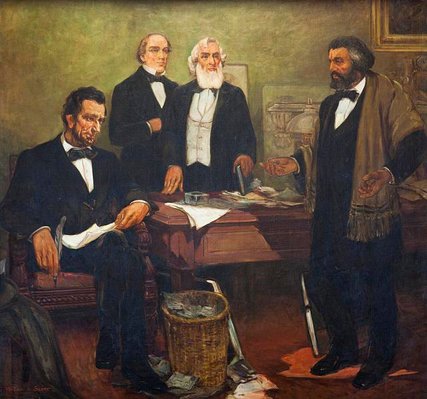
In 1881 he published his 3rd book Life and Times of Frederick Douglass. In this book he said that Abraham Lincoln was the best US president.
(A painting of Douglass (Far Right) with U.S. President Abraham Lincoln (Far Left))
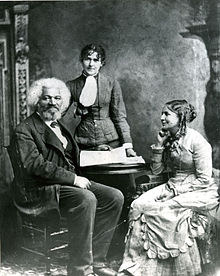
In 1877 Douglass met with is former slavemaster and reconciled. In 1882 his wife Anna Douglass died. In 1884 he remarried to  Helen Pitts, a white feminist from Honeoye, New York. He received criticism for marrying a white woman which he replied by saying that his first marriage had been to someone the color of his mother, and his second to someone the color of his father.
(Douglass (Left) with his sister in law (Middle) and his 2nd wife Helen Pitts (Right))
At the 1888 Republican National Convention, Douglass became the first African American to receive a vote for President of the United States in a major party's roll call vote. The Republic of Haiti appointed Douglass minister-resident and consul-general in 1889 and the position lasted for little over a year. In 1892, Douglass became Haiti's commissioner to the Chicago World's Columbian Exposition. Also in 1892, Douglass constructed rental housing for blacks, now known as Douglass Place, in the Fells Point area of Baltimore, MD. On February 20th, 1895 Frederick Douglass died of a heart attack and/or stroke. He was about 77 years old.
(Douglass in 1895)
Today is the 122nd anniversary of his death. Take time to remember this great abolitionist today.

Books by Frederick Douglass
  • A Narrative of the Life of Frederick Douglass, an American Slave(1845)
  • My Bondage and My Freedom (1855)
  • Life and Times of Frederick Douglass (1881)

Friday, December 16, 2016

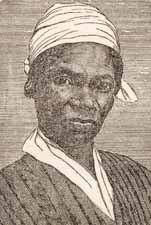
Anniversary of Sojourner Truth's Death

“I am not going to die, I'm going home like a shooting star” - Sojourner Truth
Image result for sojourner truth(Sojourner Truth)
Sojourner Truth was born as Isabella Baumfree on an unknown date in 1797 in Swartekill, New York, USA. Baumfree was born a slave. She only knew how to speak Dutch due to having Dutch slave masters. In 1806 she was sold and brought to Kingston, NY. She was beat on a daily basis. In 1808 she was sold again. In 1810 she was sold and brought to West Park, NY. In 1815 she married an older slave named Thomas. In 1826 Baumfree left her slave master along with her infant child. In 1827 her emancipation was accepted by the state of NY. One of her sons was illegal sold in 1828 and after court hearings she was able to get him returned. She was one of the first Black women to go against a White man in court and win. In 1829 she moved to New York City, NY. In 1832 Baumfree and a friend were accused of murder but were acquitted. In 1843 she became a Methodist and changed her name to “Sojourner Truth”. She then traveled and preaching about abolition. In 1844 she joined the Northampton Association of Education and Industry. She met Frederick Douglass and William Lloyd Garrison during this time. In 1846 the group disbanded. In 1850 she published the book The Narrative of Sojourner Truth: A Northern Slave.
Image result for sojourner truth 1850(A drawing of Truth)
In 1851 Truth delivered the “Ain’t I a Woman” speech in Ohio. In 1853 she met Harriet Beecher Stowe while speaking at a convention in NY. In 1856 she spoke in MI. In 1858 during a speech she was accused of being a man and she proved them wrong by exposing her breasts. In 1857 she moved to MI. In 1860 she helped recruit Black troops for the Union.
Image result for sojourner truth 1860(Truth in 1860)
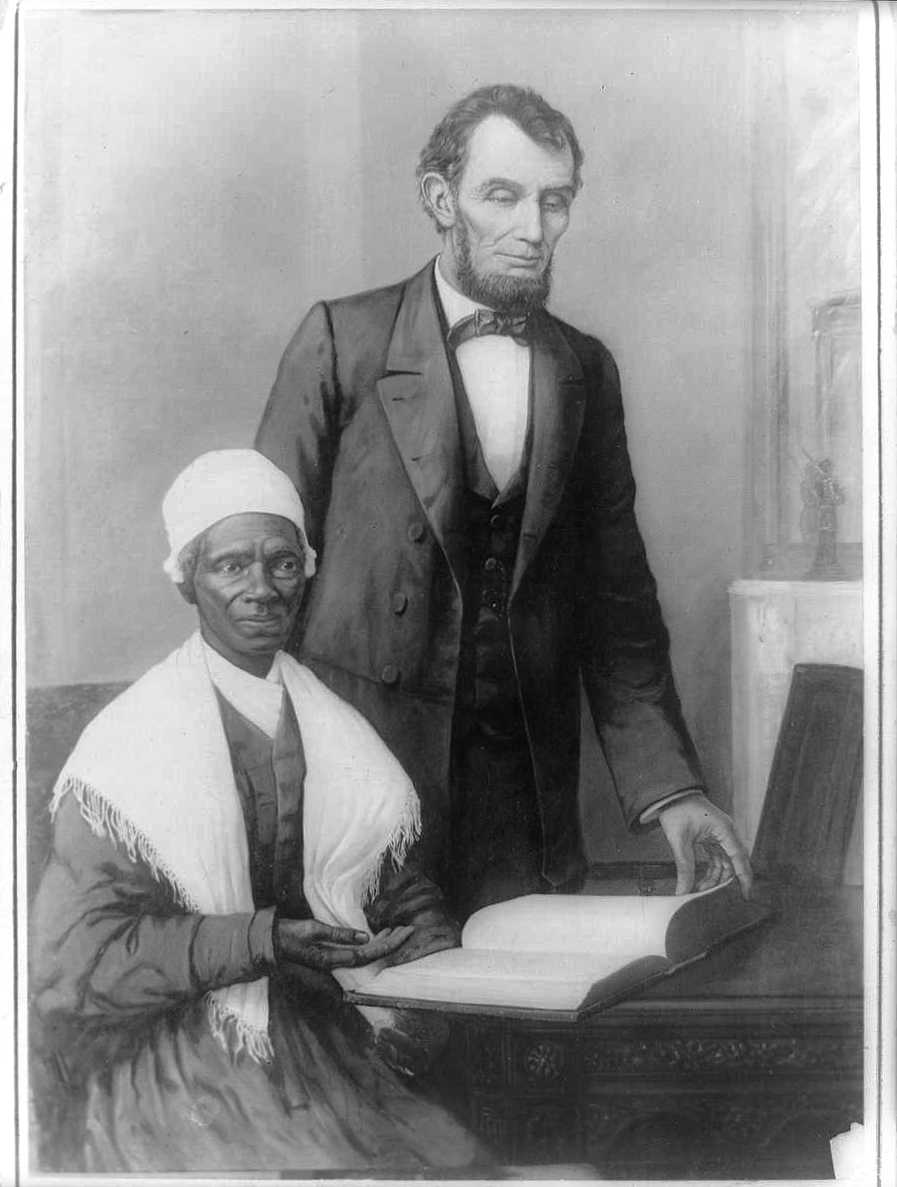
In 1864 Truth was employed by the National Freedman's Relief Association in Washington, D.C. The same year she met president Lincoln.
Image result for sojourner truth 1860(A drawing of Truth (Left) and President Lincoln (Right))
In 1865 Truth rode in the streetcars of Washington D.C. to help force their desegregation. In 1870 Truth tried to secure land grants from the federal government to former enslaved people. She also met president Grant.
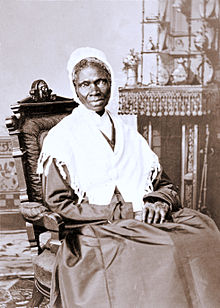
Image result for sojourner truth 1870(Truth in 1870)
In 1872 she tried to vote but was turned away. On November 26th 1883 Sojourner Truth died of natural causes in Battle Creek, Michigan, USA. She was about 86 years old.
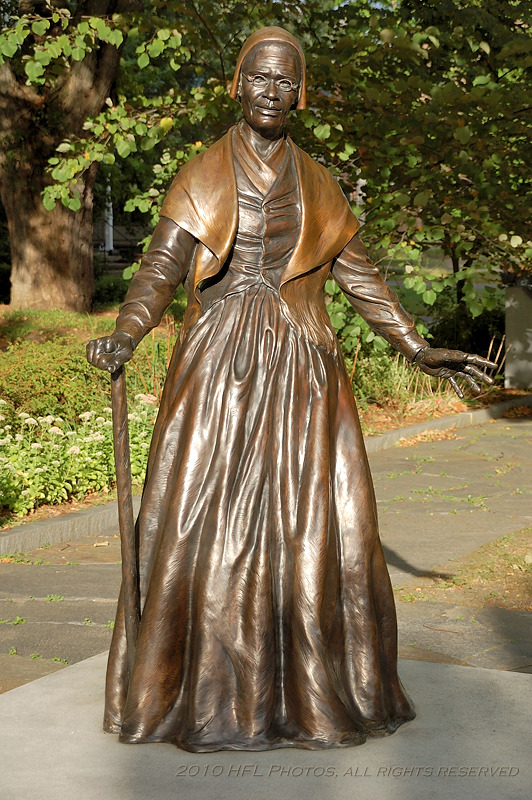
Image result for sojourner truth statue(A statue of Truth)
Today is the 133rd anniversary of her death. Take time to remember this great abolitionist today.

Books by Sojourner Truth
  • Narrative of Sojourner Truth: A Northern Slave (1850)


(P.S. sorry for the late post)

Saturday, July 30, 2016

Happy Birthday Ida B. Wells

“The only times an Afro-American who was assaulted got away has been when he had a gun and used it in self defense” - Ida B. Wells
(Ida B. Wells)
Ida B. Wells was born on July 16th, 1862 in Holly Springs, Mississippi, USA. She was born into slavery. Wells attended Shaw University but she was expelled for rebellious behavior after confronting the college president. In 1878 her parents and her infant brother died due to yellow fever. She found work as a teacher in a black elementary school in order to keep her younger siblings together as a family. Her paternal grandmother, Peggy Wells, along with other friends and relatives, stayed with her siblings and cared for them during the week while Wells was away teaching. Wells resented that in the segregated school system, white teachers were paid $80 a month and she was paid only $30 a month. This discrimination made her more interested in the politics of race and improving the education of blacks. In 1883 Wells took three of her younger siblings to Memphis, TN to live with her aunt. During her summer vacations she attended summer sessions at Fisk University. She held strong political opinions and provoked many people with her views on women's rights. In 1884 a train conductor with the Memphis and Charleston Railroad ordered Wells to give up her seat in the first class ladies car and move to the smoking car, which was already crowded with other passengers. Wells refused to give up her seat. The conductor and 2 men dragged Wells out of the car. Wells then hired an African American attorney to sue the railroad. She won the case and was awarded $500. In 1887 The railroad company appealed to the Tennessee Supreme Court, which reversed the lower court's ruling.
(Wells in 1887)
In 1889 she became co owner and editor of “Free Speech and Headlight”, an anti segregation newspaper. In 1891 Wells was dismissed from her teaching post by the Memphis Board of Education due to the various articles she had written which critiqued the conditions in the colored schools of the region. In 1889 after 3 of her friends were lynched she wrote in “Free Speech and Headlight”, urging blacks to leave Memphis, TN altogether.
(Wells in 1890)
More than 6,000 blacks did leave Memphis. Others organized boycotts of white owned businesses. After being threatened with violence, she bought a pistol. She then began investigative journalism. This officially started her anti lynching campaign. Wells found that Blacks were lynched for such social control reasons as failing to pay debts, not appearing to give way to whites, competing with whites economically, and being drunk in public. She found little basis for the frequent claim that Blacks were lynched because they had sexually abused or attacked white women, which was the alibi that partly accounted for White America's collective acceptance or silence on lynching. In 1892 while she was away in Philadelphia, PA a mob destroyed the offices of the “Free Speech and Headlight” in retaliation for her controversial articles. Wells left Memphis, TN and moved to Chicago, IL due to threats on her life. Also in 1892 Wells published a pamphlet titled “Southern Horrors: Lynch Law in All Its Phases”. Wells recommended that blacks use arms to defend against lynching.
(Wells in 1892)
In 1893 together with Frederick Douglass and other black leaders, she organized a black boycott of the World's Columbian Exposition in Chicago, IL for having no exhibits to represent African American life. In 1894 Wells took a tour to Europe in her campaign for justice. Also in 1894 Wells helped form a Republican Women's Club in Illinois in response to women being granted the right to vote for a state elective office. In 1895 Wells married her attorney Ferdinand Barnett. In 1896 Wells founded the National Association of Colored Women's Clubs and the National Afro American Council. On March 25, 1931 Ida B. Wells died of kidney failure in Chicago, Illinois, USA. She was 68 years old.
(Wells in 1931)
Today is her 154th birthday and we would all like to say happy birthday and rest in peace Ida B. Wells.


(P.S. sorry for the late post)

Thursday, March 10, 2016

Anniversary of Harriet Tubman's Death

“I freed a thousand slaves I could have freed a thousand more if only they knew they were slaves” - Harriet Tubman
(Harriet Tubman)
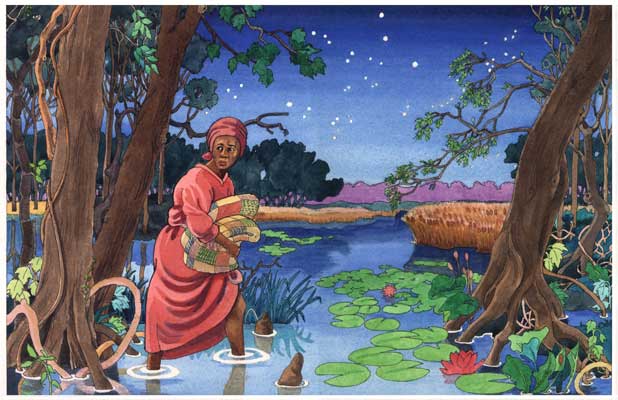
Harriet Tubman was born as Araminta Ross on an unknown date in 1822 in Dorchester County, Maryland, USA. She was born into slavery. There is a discrepancy as to what exact year she was born. Ross took care of her younger siblings because her mother worked in the slave master’s house and didn't have too much time for the children. During childhood she would find ways to resist by wearing layers of clothing as protection against beatings and fighting back. As she grew older she was assigned to working in the field. One day Ross was sent to go get supplies from a store. At the store she saw a dispute between a slave and a slaveowner. The slave tried to run out of the store away from his master and his master threw a 2 pound weight at him but he struck Ross on accident. The injury caused disabling epileptic seizures, headaches, powerful visions, and dream experiences, which occurred throughout her life. Around 1844 Ross married a free Black man named John Tubman. Soon after the marriage she changed her name to Harriet Tubman, Harriet being her mother’s name. In 1849 Tubman’s master died and there was an increased likelihood that she was going to be sold and her family broken up. On September 17th, 1849 Tubman and her 2 brothers escaped. Her brothers had second thoughts about escaping so then they all returned back. Tubman escaped again this time alone. Tubman used the Underground Railroad to help her get North. She traveled through Delaware then through Pennsylvania. While in Philadelphia, PA she worked jobs to save up money.
(A painting of Harriet Tubman escaping slavery)
In December of 1850 Tubman went to Baltimore, MD to help in the assistance of her niece and her kids escape. In the spring of 1851 she returned to help more families escape including one of her brothers. She was given the name “Moses” by abolitionist William Lloyd Garrison due to the connection of Moses from the Bible leading the Hebrews from slavery and Tubman leading African-Americans from slavery. She had a lot of help freeing slaves throughout Maryland. In the Fall of 1851 she returned to her place of birth to find her husband John Tubman. She found out that her husband had remarried and instead she found a group of slaves that she helped escape to Pennsylvania. In December of 1851 Tubman guided a group of 11 slaves into Canada due to the US’s Fugitive Slave Act of 1850. On the way to Canada they stopped at the home of abolitionist Frederick Douglass. Over 11 years Tubman freed 70 slaves from Maryland in 13 expeditions. She mostly worked in the Winter months due to the fact the nights were longer. She risked being seen by her former masters many times while going back to Maryland. She also had visions of herself speaking with God and she stated that God would protect her during her expeditions. Tubman carried firearms with her aswell for protection from slave catchers and to use if any slave she was helping was going to sell her out and get her caught.
(A painting of Tubman (Left) helping to free slaves)
A lot of slaveholders thought a Northern White abolitionist were enticing slaves to run away or that John Brown was aiding in the escape of slaves. There has been an estimation of between $12,000 and $40,000 for Tubman’s capture. Tubman was never captured and none of the slaves she helped escaped were ever captured. Abolitionist John Brown worked with Tubman to recruit supporters for an attack on slave owners. Tubman was supposed to be with John Brown on his Raid on Harper’s Ferry in 1859 but she wasn't able to be contacted. In 1859 Tubman returned to the US and lived in Auburn, New York. In November of 1860 Tubman conducted her last rescue mission and brought a group of slaves to New York. During the Civil War, Tubman brought together a group of former slaves for a regiment of black soldiers.
(A drawing of Tubman during the Civil War)
Tubman served as a nurse during the Civil War in Port Royal, SC. In 1863 she began to lead scouts through South Carolina. Tubman became the 1st woman to lead an armed assault in the Civil War. This assault involved freeing slaves from several plantations. More than 750 slaves were rescued. After the confederacy surrendered in 1865 Tubman returned to her home in New York. On her way back she was forced into the smoking car of the train she was riding and she suffered a broken arm from it while the White passengers wanted her thrown off the train. She never received any salary for her work during the Civil War. On March 18th, 1869 she was married to  a Civil War veteran named Nelson Davis. Also in 1869 a biography was written about her.
(Tubman in 1870)
In 1873 Tubman was involved in a gold swindle. In 1886 another biography about her was written. In 1896 Tubman became a speaker for the National Federation of Afro-American Women. In 1899 she finally received pension for her service in the Union Army.In the late 1890’s Tubman underwent brain surgery to help with her constant seizures, headaches, and suffering from her childhood head trauma. She didn't use anesthesia, preferring to bite down on a bullet like soldiers did in the Civil War while having limbs amputated.  In 1900 she became involved with the African Methodist Episcopal Zion Church. In 1908 a parcel of real estate that Tubman donated to her church became the Harriet Tubman Home for the Aged.
(Tubman (Left) with her family)
In 1911 she was admitted into the rest home. On March 10th, 1913 Harriet Tubman died of pneumonia in Auburn, New York. She was about 91 years old.
(Tubman in her early 90’s)
Today is the 103rd anniversary of her death. Take time to remember this great abolitionist today.


Books relating to Harriet Tubman
  • Scenes in the Life of Harriet Tubman (1869) by Sarah H. Bradford
  • Harriet Tubman: The Moses of Her People (1886) by Sarah H. Bradford
Harriet Tubman (2004) by Catherine Clinton       

Saturday, February 20, 2016

Anniversary of Frederick Douglass' Death


“It is easier to build strong children than to repair broken men” - Frederick Douglass

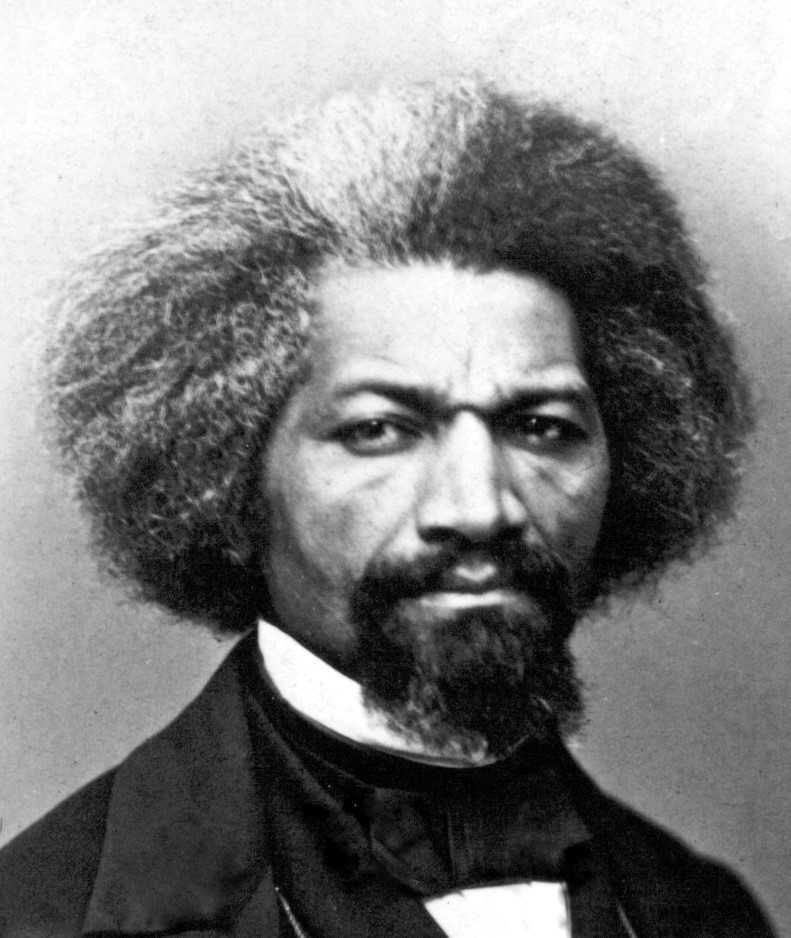
(Frederick Douglass)

Frederick Douglass was born as Frederick Augustus Washington Bailey in February of 1818 in Talbot County, Maryland, USA. He was born into slavery and the exact date of his birth is unknown. His father was a white man that he never met and his mother was a slave that his father raped. He was separated from his mother at a young age. He lived with his mother’s mother until the age of 7 where he was separated from her. His mother died when he was 10 years old. After one of his slave masters died he was moved to his deceased master’s brother in Baltimore,MD. When he was 12 his master’s wife started to teach him the alphabet.
(Douglass as a child)
His master disapproved of his wife teaching Douglass the alphabet as this may lead to him eventually wanting freedom. In private Douglass taught himself to read by reading newspapers, pamphlets and other forms of media. When his master hired him out to another slave master he taught those slaves to read the Bible at a sunday school which he taught classes at. More than 40 slaves would attend the class. These classes went on for 6 months unnoticed until 1 sunday a group of slave masters busted in to disperse the class. His 1st slave master took Douglass back and sent him to another slavemaster with the reputation of a “Slave Breaker”. Douglass was beat regularly and he was nearly broke mentally. At 16 years old Douglass finally fought back and beat his slave master in a fight and he was never whipped or beat again. In 1836 Douglass tried to escape but was unsuccessful. In 1837 Douglass met and fell in love with a free Black woman in Baltimore who was 5 years older than him named Anna Murray.
(Anna Murray, wife of Frederick Douglass, at about 44 years old)
Moreover, on September 3rd, 1838 Douglass successfully escaped by a train that was traveling North. He traveled through the slave state of Delaware disguised as a sailor with fake documents saying he was a free man. He then got into the free state of Pennsylvania. From Pennsylvania he moved up to New York City, NY and stayed with a well known abolitionist. After settling in New York City he sent for his girlfriend Anna Murray. They married on September 15th, 1838. They adopted the name Johnson as their last name. They then moved to New Bedford, MA. They then changed their last name again to Douglass. Douglass became a licensed preacher in 1839. In 1840 he delivered a speech in Elmira, NY which was a station for the underground railroad. Douglass became a regular at abolitionist meetings in New Bedford, MA. Douglass drew inspiration from abolitionist William Lloyd Garrison. In 1841 Douglass heard Garrison speak at a meeting of the Bristol Anti-Slavery Society. At another meeting Douglass was unexpectedly invited to speak of his story of escaping slavery. Douglass was encouraged to become an anti-slavery lecturer. At 23 years old he spoke at an anti-slavery convention in Nantucket, MA. In 1843 Douglass joined other speakers on a 6 month tour through the Eastern and Midwestern parts of the US. At a lecture in Pendleton, Indiana an angry mob of slavery supporters chased and beat Douglass. He was rescued by a Quaker family.

Furthermore, Douglass suffered a broken hand that never healed properly. In 1845 Douglass published his book Narrative of the Life Frederick Douglass, An American Slave. Within three years, it had been reprinted nine times, with 11,000 copies circulating in the United States. It was also translated into French and Dutch and published in Europe.In 1845 Douglass went to tour Europe. on the 16th of August 1845 he arrived in Liverpool, England. He then traveled to Ireland. Douglass spent 2 years in Ireland and England. During his trip Douglass became legally free. Douglass returned to the US in Spring of 1847.
(Frederick Douglass in 1847)
Douglass published the first abolitionist paper called The North Star in Rochester,NY. In September of 1848 Douglass wrote a letter to his former slave master berating him for his conduct, and enquiring after members of his family still held by him. In 1848, Douglass was the only African American to attend the Seneca Falls Convention, the first women's rights convention, in upstate New York. Douglass stood and spoke eloquently in favor of women’s suffrage; he said that he could not accept the right to vote as a black man if women could not also claim that right. In 1851 Douglass merged The North Star with Gerrit Smith's Liberty Party Paper to form Frederick Douglass' Paper, which was published until 1860. On July 5, 1852, Douglass delivered an address to the ladies of the Rochester Anti-Slavery Sewing Society. This speech became known as “What to the slave is the 4th of July?".
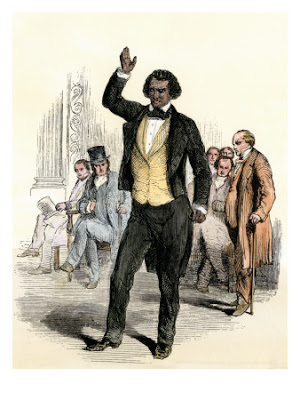
(A drawing of Douglass performing his speech)
Douglass met with abolitionist John Brown two months before Brown lead his raid on the federal armory in Harpers Ferry. Douglass disapproved of Brown's plan to start an armed slave rebellion in the South. After the raid, Douglass fled for a time to Canada, fearing guilt by association as well as arrest as a co-conspirator.
(A drawing of John Brown (Left) and Frederick Douglass (Right))
In 1855 he published his 2nd book My Bondage and My Freedom.
(Douglass in 1856)
Douglass conferred with President Abraham Lincoln in 1863 on the treatment of black soldiers, and with President Andrew Johnson on the subject of black suffrage. During the U.S. Presidential Election of 1864, Douglass supported John C. Frémont. Douglass was disappointed that President Lincoln did not publicly endorse suffrage for blacks. Douglass believed that since African-American men were fighting for the Union in the American Civil War, they deserved the right to vote. Douglass helped the Union by serving as a recruiter for the 54th Massachusetts Infantry Regiment. In 1870, Douglass started his last newspaper, the New National Era, attempting to hold the US to its commitment to equality. In 1872, Douglass became the first African American nominated for Vice President of the United States, as Victoria Woodhull's running mate on the Equal Rights Party ticket. He was also presidential elector at large for the State of New York, and took that state's votes to Washington, D.C. His home in Rochester, NY was burned down by a suspected arsonist. Douglass then moved to Washington D.C.
(Douglass in the 1870’s)
In 1881 he published his 3rd book Life and Times of Frederick Douglass. In this book he said that Abraham Lincoln was the best US president.
(A painting of Douglass (Far Right) with US President Lincoln (Far Left))
In 1877 Douglass met with is former slavemaster and reconciled. In 1882 his wife Anna Douglass died. In 1884 he remarried to  Helen Pitts, a white feminist from Honeoye, New York. He received criticism for marrying a white woman which he replied by saying that his first marriage had been to someone the color of his mother, and his second to someone the color of his father.
(Douglass (Left) with his sister in law (Middle) and his 2nd wife Helen Pitts (Right))
At the 1888 Republican National Convention, Douglass became the first African American to receive a vote for President of the United States in a major party's roll call vote. The Republic of Haiti appointed Douglass minister-resident and consul-general in 1889 and the position lasted for little over a year. In 1892, Douglass became Haiti's commissioner to the Chicago World's Columbian Exposition. Also in 1892, Douglass constructed rental housing for blacks, now known as Douglass Place, in the Fells Point area of Baltimore, MD. On February 20th, 1895 Frederick Douglass died of a heart attack and/or stroke. He was about 77 years old.
(Douglass in 1895)
Today is the 121st anniversary of his death. Take time to remember this great abolitionist today.

Books by Frederick Douglass
  • A Narrative of the Life of Frederick Douglass, an American Slave (1845)
  • My Bondage and My Freedom (1855)
  • Life and Times of Frederick Douglass (1881)